
Essential Oil Incense Cones: A Friendly Aussie Guide
The verandah door is open, the last of the Sunshine Coast light is turning everything honey-gold, and you're ready for a little exhale. You light a small cone, settle back with your cuppa, and let the room shift from busy-day mode to something softer. That's the appeal of essential oil incense cones, a compact fragrance ritual with plenty of atmosphere, provided you give the smoke, ingredients and ventilation the respect they deserve.
They're often described as a natural alternative to synthetic home fragrance, but “natural” doesn't automatically mean harmless in every situation. Australian guidance raises practical questions around asthma, indoor air, allergens, children and pets, so choosing and burning cones well matters just as much as choosing a scent you adore.
Table of Contents
- What Essential Oil Incense Cones Actually Are
- How a Cone Is Made and How It Burns
- Cones Compared with Sticks, Coils and Resin
- The Feel-Good Benefits and Honest Air-Quality Notes
- Scent Families to Fall in Love With, Australiana Style
- Safe Burning Tips and Care for Your Cone Ritual
- Reading the Label, Ingredients, Sustainability and What Makes a Quality Cone
- Choosing the Right Cone for You or as a Gift
What Essential Oil Incense Cones Actually Are
Essential oil incense cones are small, combustible pieces of aromatic material shaped into a cone. A typical cone combines a burnable plant-based material, such as wood powder or makko powder, with a binder and fragrant ingredients. In the style discussed here, pure essential oils provide the scent rather than relying solely on synthetic fragrance oils.
Some are standard cones, while others are made for backflow burners. A backflow cone has a hollow channel that encourages smoke to travel downwards through a specially designed burner, creating that little waterfall effect. A regular cone sends its smoke upwards, so it doesn't need the carved steps, pools or ceramic smoke caves that backflow burners use.
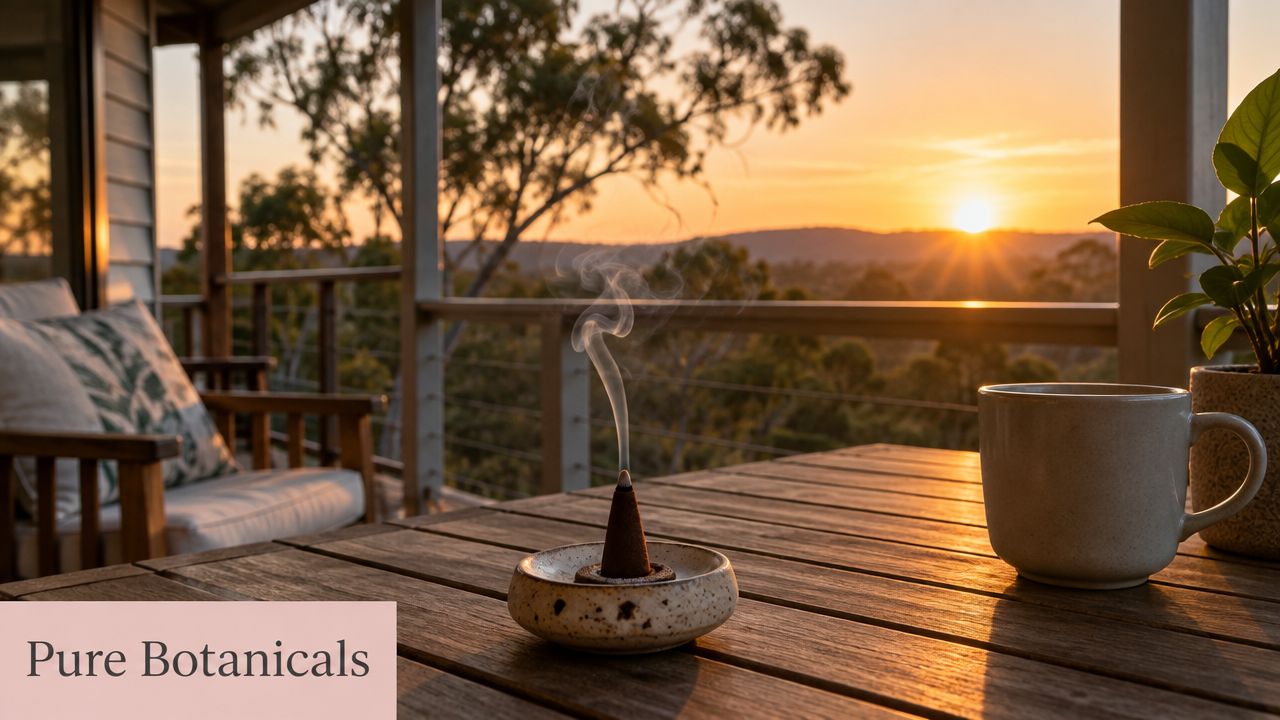
A cone isn't a diffuser
It's easy to confuse incense with an oil burner. A diffuser disperses fragrance without burning the scented material itself. An oil burner warms diluted oil, usually with water, above a candle. An incense cone, however, smoulders through its own body, creating both fragrance and smoke.
That gives cones a smokier, more ritual-like quality than a reed diffuser or room spray. They're also different from an essential oil candle, where fragrance is released as wax melts around a wick. Cones suit a short, intentional pause, while a diffuser or candle may provide a gentler background presence.
For Australian small-batch makers and boutique retailers, cones can also fit naturally into giftable, handcrafted collections. They're compact, easy to pair with a burner, and offer shoppers a tactile way to explore scent. The important question isn't whether a cone smells lovely before lighting. It's whether the maker explains the base, fragrance ingredients, care instructions and intended use clearly.
How a Cone Is Made and How It Burns
A quality cone begins with the base. Finely milled combustible powders are blended with a binder and enough water to create a workable dough. The maker then incorporates the aromatic ingredients, shaping the mixture by hand or pressing it into a mould.
Essential oils can be delicate, so temperature and handling affect the finished aroma. Once the dough is formed into a pyramid shape, the cones need to dry thoroughly before they're packaged. A cone that still holds moisture may struggle to light or burn unevenly, while an overly dry or poorly compacted cone can burn too quickly.
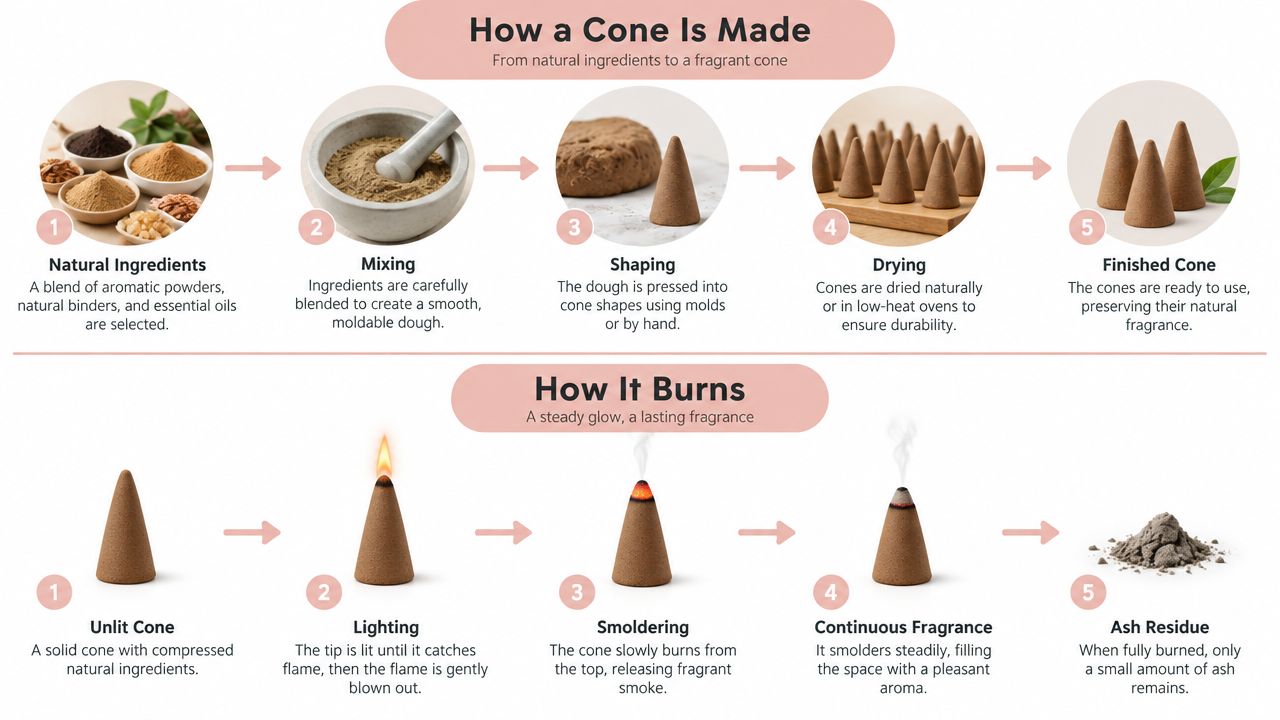
The burn, step by step
- Place the cone securely. Use a heat-resistant holder on a stable, non-flammable surface. Timber, rattan and fabric need protection underneath.
- Light the tip. Let the flame catch briefly, then gently blow it out. You're looking for a steady glowing ember, not a dancing flame.
- Let the ember travel. The cone smoulders downwards through its scented body, releasing aroma as the binder and botanicals burn.
- Use the right burner for backflow. A hollow-tipped backflow cone needs a backflow burner to create the downward cascade. Without one, it'll behave much like an ordinary cone.
The whole body of a cone burns, so its scent can feel fuller and more atmospheric than the narrow stream from a stick. Burn time depends on the cone's size, density and formula, so follow the maker's instructions rather than assuming every cone behaves alike.
Blushing Ivy Luxury Incense is a stick format rather than a cone, with fragrances including Sea Salt, Sandalwood & Vanilla, Sweet Orange, Bergamot & Patchouli, and Basil, Neroli & Jasmine. Its care guidance recommends a heat-resistant holder, a stable non-flammable surface, ventilation, and keeping burning incense away from children and pets. Blushing Ivy Luxury Incense is a useful reminder that format changes the burn experience, but safe use remains essential.
Cones Compared with Sticks, Coils and Resin
Choosing incense is a bit like choosing footwear. A sandal might be perfect for the beach, while boots are better for a muddy hinterland walk. Cones, sticks, coils and resin each create a different rhythm in the home.
A stick sends fragrance from a slim, linear source and usually needs a holder that catches ash. It can suit a desk, reading nook or gentle practice where you want a defined stream of smoke. Coils are larger and designed to burn for longer, making them more suited to spacious areas or outdoor entertaining, although their smoke can feel heavier.
Resin sits at the more traditional, hands-on end of the spectrum. You need a charcoal disc, a heat-proof dish and a little more attention as the resin heats. The scent can be wonderfully deep and potent, but it isn't always the easiest starting point for someone who wants to freshen the sitting room before guests arrive.
| Format | Burn Time | Smoke Level | Best For |
|---|---|---|---|
| Cone | Short, depending on size and density | Moderate, concentrated at one point | Small rituals, gifting and compact spaces |
| Stick | Varies by length and construction | Usually a narrower stream | Desks, reading and gradual fragrance |
| Coil | Extended, depending on the coil | Often heavier | Larger areas and outdoor use |
| Resin | Depends on the charcoal and amount used | Strong and direct | Traditional, ceremonial or deeply aromatic sessions |
Why cones appeal to beginners
Cones sit in the middle. They're more self-contained than sticks, less involved than resin, and generally easier to portion than a long coil. A single cone can mark the start of journalling, a quiet bath or a tidy-up ritual without turning the whole evening into a production.
That convenience doesn't make them risk-free. All burning incense creates smoke, so “gentler” should describe the experience, not promise clean air or a health benefit. Your room size, airflow and personal sensitivity matter more than a pretty label.
The Feel-Good Benefits and Honest Air-Quality Notes
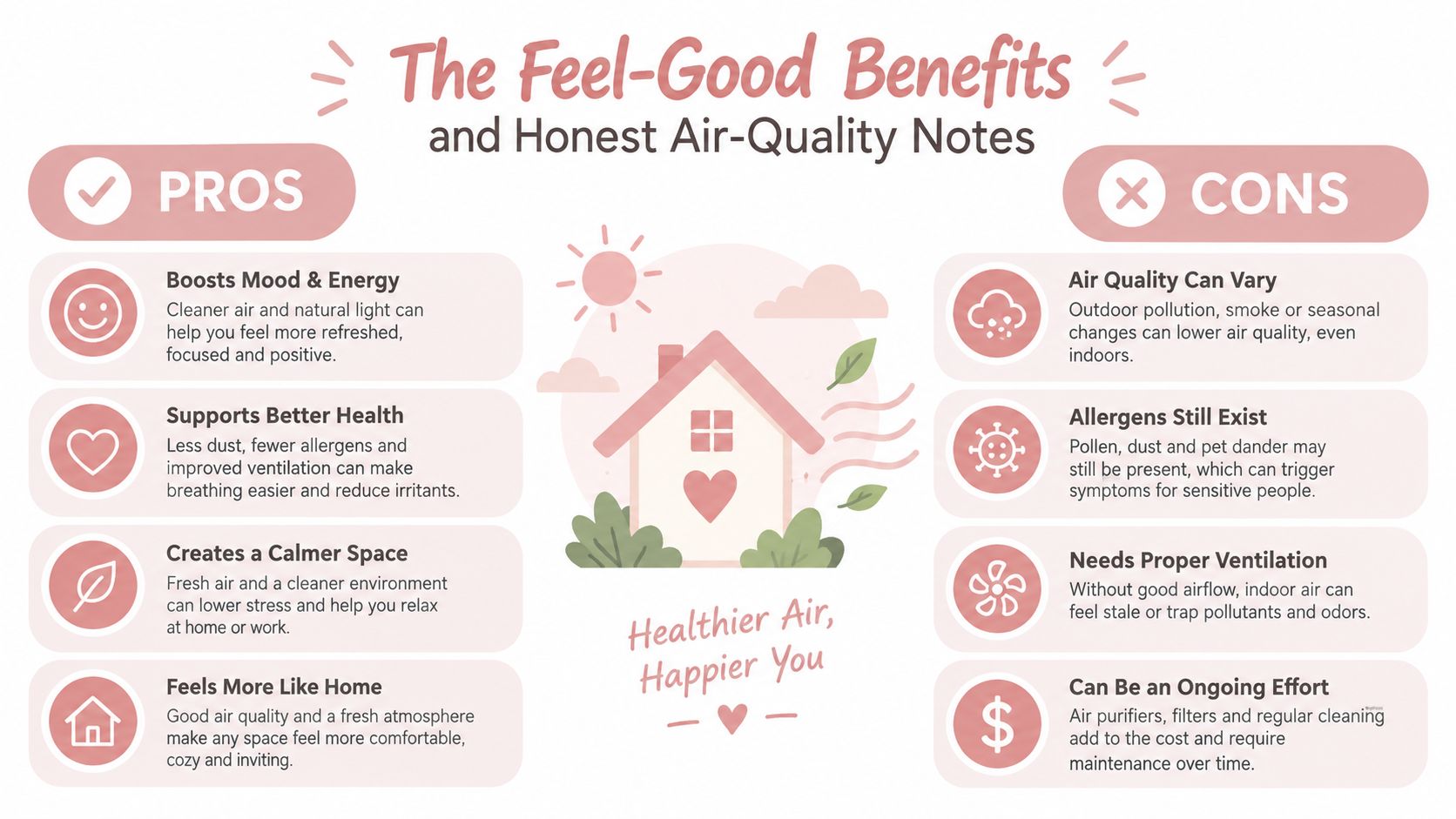
Scent can change the emotional tone of a room very quickly. A bright citrus aroma may make the kitchen feel fresh after cooking, while sandalwood or a soft floral blend can help signal that work is finished and your slower evening has begun. Those associations are personal, too. The smell of eucalyptus might feel invigorating to one person and remind another of rainy school mornings.
That mood-lifting ritual is real as an experience, but it shouldn't be confused with a medical treatment. Essential oils are still concentrated aromatic substances, and burning them creates smoke. Natural doesn't mean smoke-free, and essential-oil-based incense isn't automatically safer to inhale in unlimited amounts.
What Australian evidence tells us
Australian health guidance identifies incense and essential oils as potential asthma triggers. It recommends minimising smoke exposure through smoke-free practices and good ventilation, which makes room choice and burn frequency important for sensitive households. Better Health Victoria's asthma-friendly home guidance is a helpful reference if anyone in your home has asthma.
Research from Queensland University of Technology found that incense combustion can emit secondary pollutants, including about 0.38 ppb isocyanic acid and 3 to 9 ppb ammonia above background, with absolute ammonia levels reaching 30 to 38 ppb during burning. The published Australian air-quality research supports reducing incomplete combustion by considering factors such as binder load, cone density and burn rate.
Practical rule: Treat incense as a fragrance ritual, not an air purifier. Crack a window when conditions allow, keep smoke away from sleeping areas, and stop burning if anyone feels irritated, wheezy or headachy.
A soy candle has a different combustion pattern from an incense cone, but it still needs sensible care. The Wild Heath Society Deluxe Soy Candle belongs to a separate candle range with scents such as Revolution, Whisky Bar, Hole in One, Barbershop and Campfire. It's a reminder that choosing between candles and cones is about the atmosphere you want, not a promise that one burning product is universally suitable for every home.
For a deeper Australian-focused discussion, this guide to whether natural incense is bad for you is worth reading before making incense part of your regular routine.
Scent Families to Fall in Love With, Australiana Style
A scent family works best when it gives you a feeling, not just a shopping label. Think about where you'd like the aroma to take you. Is it a breezy coastal morning, a shaded forest track or a warm evening with the barbecue still ticking away?
Bush florals
Boronia, wattle and native rose can create a soft, distinctly Australian floral mood. These scents feel uplifting without necessarily becoming sugary, like walking past flowering scrub on a sunny morning. They suit entryways, dressing areas and those moments when the house needs a little lift.
A bush-floral cone can also make a thoughtful gift for someone who loves native gardens or Australian-made design. It has a sense of place without shouting, “G'day, I'm a novelty souvenir.”
Coastal and citrus notes
Eucalyptus, sea salt and lemon myrtle bring freshness and movement. They suggest clean linen, salty air and the bright green snap of leaves after rain. Use this family in living spaces, bathrooms or before visitors arrive, when you want the room to feel open and refreshed.
Citrus can be especially lovely in daytime rituals. Sweet orange and bergamot feel sunny and easygoing, while lemon myrtle has a sharper Australian character that can wake up a tired corner.
Warm spice and woodland blends
Sandalwood, cinnamon leaf and Tasmanian pepperberry create a grounded, cosy profile. These scents belong beside a book, a woolly throw and a cup of tea, even if Queensland weather means the “cosy” part involves a fan and not a roaring fire.
For a greener direction, cypress, rosemary and kunzea bring a forest-like freshness. They're well suited to meditation, study or a home office where you want a clear, steady atmosphere rather than something overtly sweet.
Safe Burning Tips and Care for Your Cone Ritual
A cone ritual should feel calming from the first match to the final cool-down. The safest setup is wonderfully simple: a suitable burner, a clear surface and enough ventilation for the room to breathe.
Australian incense guidance recommends using a heat-proof surface, never leaving burning incense unattended, keeping it away from children and pets, and allowing ash to land on a heatproof tray. Cones burn through to the base, so don't place one directly on timber or a shelf and hope for the best. Hope is not a fire-safety system, lovely.
A sensible cone checklist
- Choose the holder first. Use a stable ceramic, brass or other heat-resistant burner designed to contain heat and ash.
- Clear the landing zone. Keep the cone away from curtains, bookshelves, paper, cushions, rattan and anything that could catch or scorch.
- Watch the airflow. Ceiling fans, strong breezes and open windows can make the ember burn unevenly. During bushfire smoke or poor-air events, skip indoor burning rather than adding more smoke to the room.
- Keep curious little noses away. Children and pets shouldn't have access to lit cones, loose cones or essential oils.
- Stay nearby. Extinguish the cone if you're leaving the room. When it looks finished, let the burner cool and make sure no ember remains before disposing of anything.
- Store with care. Coastal humidity can affect dry aromatic products. Keep cones sealed in a cool, dry place away from direct sunlight, and don't store them beside a steamy bathroom window.
Shorter sessions can give you more control, especially if you're testing a new scent or have a sensitive nose. For a gentle ritual, light the cone, allow the fragrance to build, then extinguish it once the room feels right. The Blushing Ivy meditation incense guide offers another perspective on using incense as part of a mindful practice, without turning your lounge room into a smoke machine.
Reading the Label, Ingredients, Sustainability and What Makes a Quality Cone
A beautiful box can't tell you everything. Before buying essential oil incense cones, look for a clear ingredient description and practical care instructions. A maker who explains the combustible base, binder and fragrance approach gives you more useful information than a label that just says “natural” in oversized lettering.
Makko powder and other plant-based binders can help a cone hold its shape and burn. Charcoal may be included in some formulas, particularly where a strong ember is needed, but shoppers who want a lighter, more transparent formula should ask what the charcoal does and what else sits alongside it. Synthetic fragrance isn't automatically a reason to panic, but it should be identified accurately rather than hidden behind vague wording.
Label-reading shortcut: Look for the actual fragrance ingredients, the intended burner, ventilation advice and a named maker. If a product makes therapeutic promises but doesn't explain its regulatory status, be cautious.
Transparency matters in Australia
Australian flavour and fragrance chemicals used in consumer products are regulated as industrial chemicals. Businesses importing or manufacturing them commercially may need to register, and the regulator places chemicals into categories including Listed, Exempted, Reported, Assessed or Commercial Evaluation Authorisation. This Australian fragrance compliance explainer gives useful context for brands working with imported or locally blended fragrance inputs.
The rules can also depend on sourcing and production. The Australian Industrial Chemicals regulator states that products made using 100% locally sourced ingredients don't require registration when the process doesn't involve a chemical reaction or create additional industrial chemicals. That doesn't remove every business responsibility, but it shows why “Australian-made” and “locally sourced” aren't interchangeable phrases. This Australian-made natural perfume discussion explains the distinction in practical terms.
Check for batch information, packaging details and realistic claims. Recyclable or compostable packaging can be a positive, but sustainability is bigger than a green-looking box. Consider the ingredients, transport, packaging volume and whether the maker can explain where the product is made.
For a plain-English look at the difference between essential oils and fragrance oils, this Blushing Ivy fragrance guide can help you compare labels without getting lost in perfume jargon.
Choosing the Right Cone for You or as a Gift
Start with the room and the person, not the prettiest product name. A rich resinous scent might feel delicious in a spacious living area but overwhelming beside a desk. A bright citrus or coastal blend can make a fresh-home enthusiast very happy, while lavender, sandalwood or a quiet woody aroma may suit the overworked mate who needs their evening to feel less like a second shift.
For a couple, warm spice and floral notes can create a soft, romantic atmosphere. For someone who's new to incense, choose a gentle scent and pair it with a simple ceramic burner. A small taster bundle is often more thoughtful than guessing one large box, particularly when you don't yet know whether they love eucalyptus, sandalwood or something sweeter.
A quick matching guide
- For the calm-seeker: Choose gentle woods, lavender-style florals or soft herbal notes, and suggest using them during journalling or a quiet bath.
- For the bright-home person: Look for citrus, sea salt, lemon myrtle or fresh green profiles that suit kitchens, living rooms and daytime resets.
- For the entertainer: Warm spice, amber-like depth or layered wood notes can make a room feel welcoming before friends arrive.
- For the Australian design lover: Native botanicals and Australiana-inspired fragrance give the gift a sense of place without relying on novelty packaging.
If you're building a broader housewarming present, you might enjoy this guide to gifts for every occasion. Pairing incense with a burner, a handwritten scent menu and another home fragrance item makes the ritual feel personal rather than picked straight from a checkout page.
For homes with children, pets, asthma or fragrance sensitivities, include the safety information with the gift. Essential oils aren't safe to consume and can cause significant poisoning if swallowed. Western Australian guidance directs people to the Poisons Information Centre on 13 11 26 for advice, so keep cones and oils securely stored and never describe a scented product as edible or medicinal. HealthyWA's essential oil safety advice is a useful Australian reference.
Blushing Ivy's Sunshine Coast perspective is all about making fragrance feel warm, useful and connected to everyday Australian life. Whether you choose cones, a candle, a Room & Linen Spray or Fragrance Diffusers, look for a product whose ingredients, care instructions and mood suit the person receiving it.
Explore the Australian-made, handcrafted collection at Blushing Ivy Home Fragrance, including natural incense and Sunshine Coast-inspired candles, diffusers and room fragrances. Choose a scent for your own evening ritual or put together a thoughtful gift, then light it gently, ventilate well and enjoy the little pause it creates.