
Essential Oil Soy Candles Guide for a Cleaner Home Glow
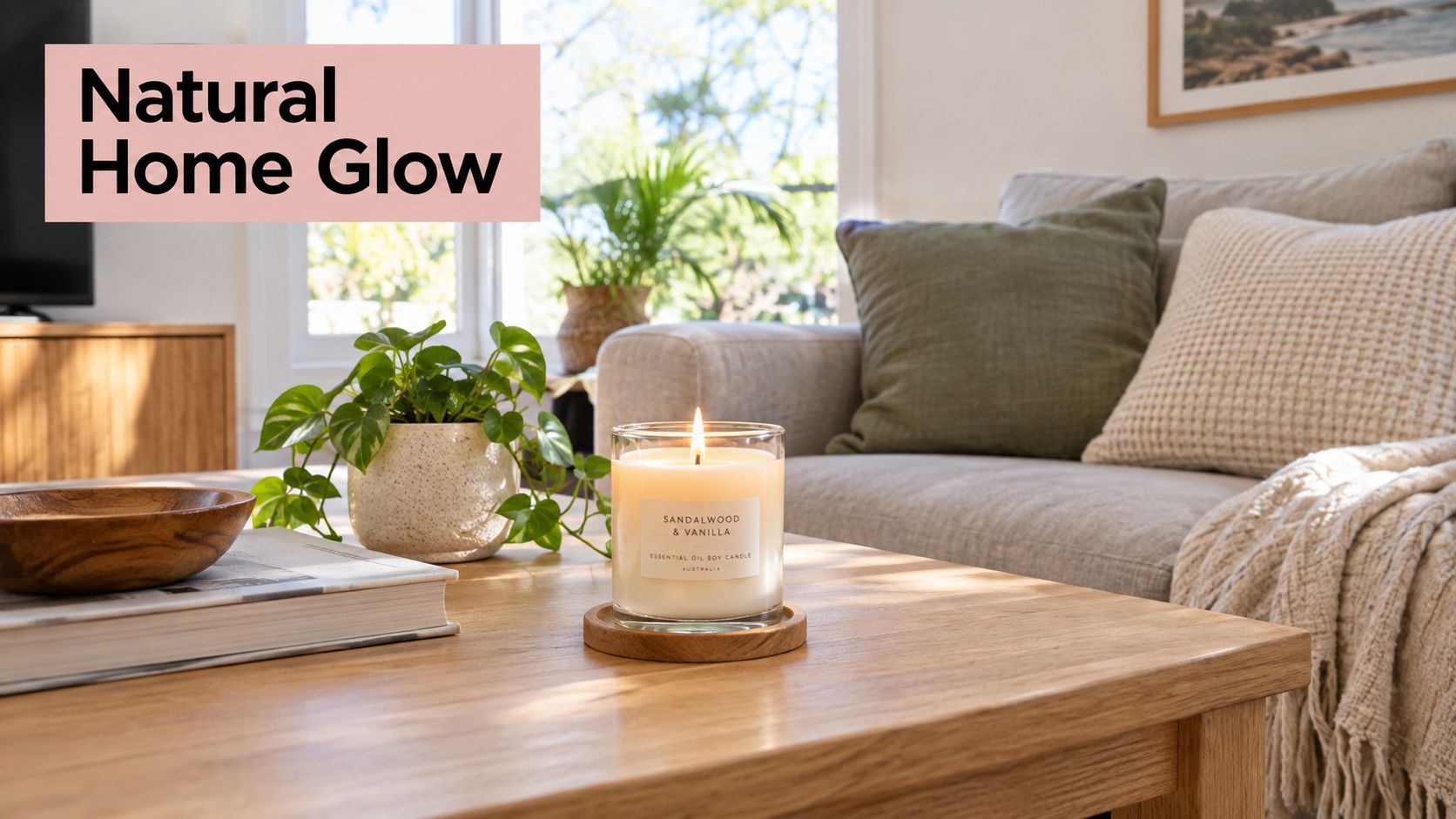
The kettle's just clicked off, the afternoon light is slipping across the lounge room, and the house feels like it needs one small finishing touch. You light a candle, the flame settles, and suddenly the room carries sandalwood, vanilla, warm timber and a hint of holiday calm. That little ritual is why essential oil soy candles have become such a lovely choice for Australian homes.
They offer a plant-based wax, botanical fragrance character and a soft glow that suits everything from a Sunshine Coast beach house to a cosy apartment in Melbourne. But “natural” doesn't automatically mean stronger, safer or better made. The details matter, including the wax, fragrance dosage, wick, vessel, ventilation and the way you burn it.
This guide is for anyone who wants a beautiful home fragrance without having to decode a chemistry textbook first. We'll look at how these candles work, where essential oils shine, where fragrance oils may perform differently, how to spot thoughtful formulation, and how to enjoy your candle safely. Along the way, there'll be a few Australian scent stories too, because eucalyptus, banksia, coastal air and native honey deserve more than a dry list of notes.
Table of Contents
- Introduction to Essential Oil Soy Candles at Home
- What Essential Oil Soy Candles Are and How They Work
- Soy Wax and Essential Oils Compared With Other Options
- Scent Profiles and Australiana Inspiration for Every Room
- Safety and Sustainability Truths Behind Natural Claims
- How to Choose Quality and Make Your Candles Last
- Gifting and Styling Ideas With Essential Oil Soy Candles
Introduction to Essential Oil Soy Candles at Home
A good candle does more than make a room smell sweet. It can turn the end of a long workday into a slower evening, make a guest room feel welcoming, or bring back the memory of sunscreen, salty air and a hot summer afternoon. Scent has a funny way of travelling straight past the sensible part of the brain and landing somewhere much more personal.
That's especially true with Australian-inspired fragrance. A fresh eucalyptus profile can feel invigorating after a sticky Queensland day, while warm woods and soft vanilla create the indoor equivalent of a favourite knitted jumper. The best scent isn't necessarily the loudest one. It's the one that feels right in your space and suits the mood you want to create.
Australia's candle market was valued at AUD 130.57 million in 2025 and is projected to reach AUD 200.84 million by 2035, growing at a 4.40% CAGR over that period, according to Expert Market Research Australia's candle market coverage. The same coverage identifies soy wax as one of the key raw-material categories, reflecting how plant-based waxes have found a place in the country's home-fragrance market.
A considered choice, not a perfect label
People often choose essential oil soy candles because they want a cleaner-feeling, more natural-looking product. That preference makes sense, but it's worth looking beyond the front label. A candle's experience depends on the whole design, not just whether the wax is soy or the scent begins with a botanical ingredient.
A carefully balanced candle should give you a steady flame, an even melt pool and fragrance that feels present without taking over the room. It should also come with sensible care information, because safe use depends on both the maker and the person lighting it.
The useful question isn't simply “Is it natural?” It's “How has it been formulated, and how will I use it?”
That's the lens we'll use here. You'll find practical guidance for choosing a candle, matching scent to room and mood, avoiding common burn problems, and selecting a thoughtful Australian-made gift. No dramatic promises, no fearmongering, just the helpful details that make a lovely candle even better.
What Essential Oil Soy Candles Are and How They Work
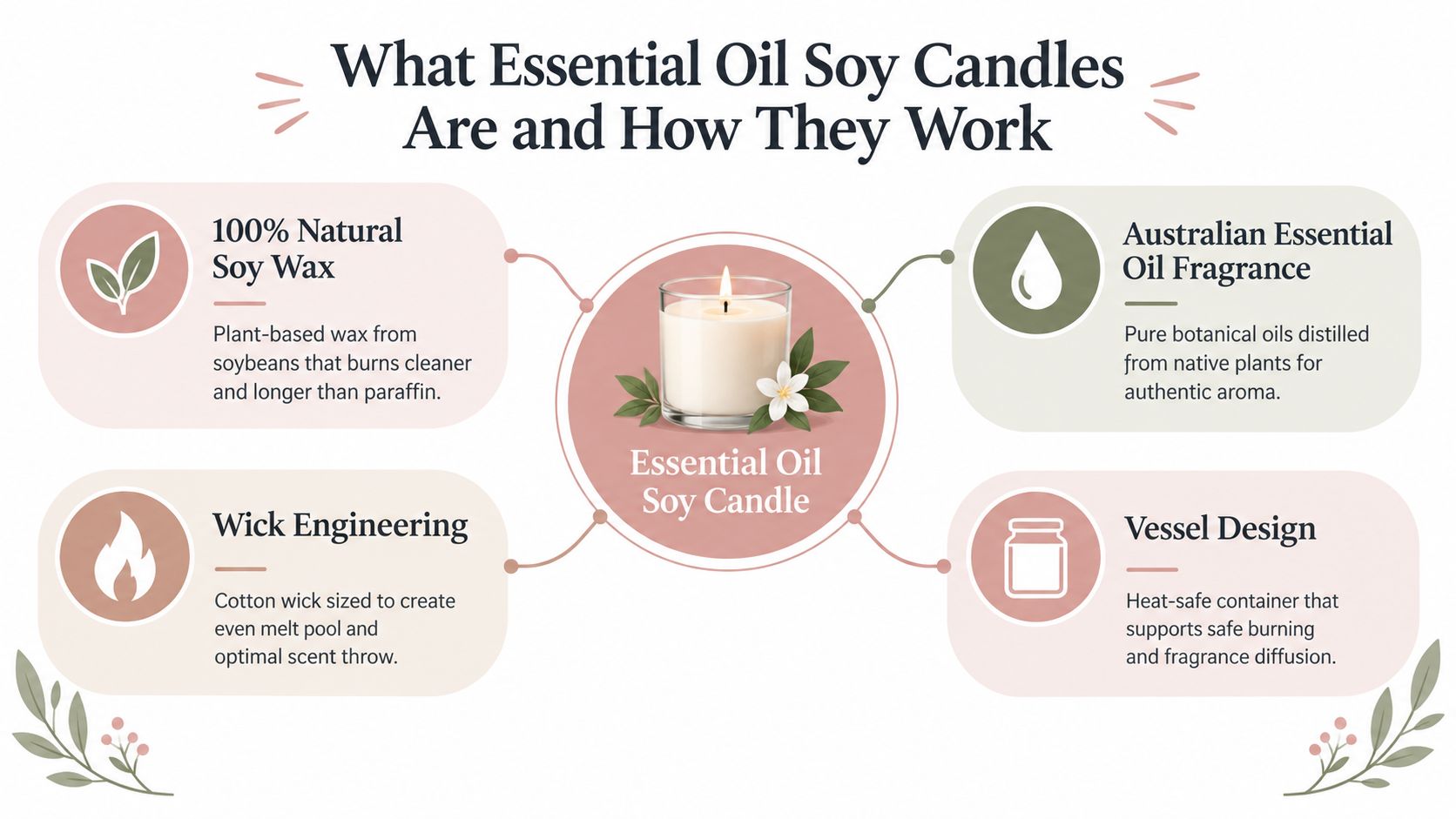
An essential oil soy candle has four working parts: wax, fragrance, wick and vessel. Think of the wax as the candle's fuel tank, the fragrance as the character it carries, the wick as the little engine controlling the flame, and the vessel as the structure that keeps everything in place.
Soy wax begins as soybean oil and is used as a plant-based candle wax. Blushing Ivy candles use 100% pure soy wax, lead-free cotton wicks and Australian-made, essential oil-based fragrance. Those ingredients create the foundation, but the final result still depends on how they've been brought together.
The melt pool carries the scent
When you light a candle, the flame melts the wax around the wick. That liquid wax travels up the wick, where heat turns it into vapour that supports the flame. Fragrance is carried through that melted wax and released as the candle burns.
Fragrance loading is one of the most important formulation variables. Australian candle-making guidance commonly places soy-candle fragrance load around 6–10% by weight, with 10% often treated as an upper working limit for soy wax. In practical terms, that means 60–100 g of fragrance per 1,000 g of wax, as explained in this Australian fragrance-loading guide.
More fragrance doesn't automatically mean more scent. If the wax can't absorb the added material properly, the candle may burn poorly, release fragrance unevenly or become less stable. Makers should measure by weight and test small batches rather than guessing.
The wick sets the pace
A wick that's too small may leave unmelted wax around the sides, creating tunnelling. A wick that's too large can create an overly vigorous flame, excess heat and an untidy burn. Wick size must suit the wax, fragrance concentration, vessel diameter and intended burn behaviour.
Trimming also matters. A shorter, tidy wick helps manage the flame and minimise soot build-up. In everyday use, keep the wick within the maker's recommended range rather than treating trimming as an optional bit of candle housekeeping.
The vessel has a job too. It needs to tolerate heat, sit securely and give the melt pool enough room to form without placing nearby surfaces at risk. A simple opaque glass jar can be elegant, practical and reusable once the wax is gone.
The Classic Soy Candle illustrates this straightforward approach, with a 100% soy wax candle in an opaque white glass container, Australian-made essential oil-based fragrance and lead-free cotton wick. Its care guidance recommends setting the candle memory on the first burn, trimming the wick to 2–5 mm and keeping the candle away from draughts, children and pets.
Soy Wax and Essential Oils Compared With Other Options
Soy wax and essential oils appeal to shoppers for different reasons, so it helps to compare each choice separately. Soy wax is plant-based, while paraffin is petroleum-derived. Essential oils come from botanical materials, while fragrance oils are developed blends that can be designed for particular scent effects and burn performance.
Neither comparison needs a cartoon hero and villain. A candle can be beautifully made with different materials, and a natural ingredient can still require careful handling. The right option depends on whether your priority is botanical character, strong scent throw, consistency, sustainability preferences or a particular room atmosphere.
For a broader explanation of the wax question, Blushing Ivy's guide to soy wax versus paraffin wax is a useful companion read.
A practical decision matrix
| Option | Best For | Trade-off to Know |
|---|---|---|
| Soy wax | Shoppers who prefer a plant-based wax and a soft, creamy candle aesthetic | It still needs suitable wick sizing and balanced fragrance loading |
| Paraffin wax | Makers seeking a familiar wax with established fragrance and burn characteristics | It's petroleum-derived, which may not suit a plant-based purchasing preference |
| Wax blends | People looking for a combination of handling or performance qualities | The label needs checking because the experience depends on the specific blend |
| Essential oils | Botanical, nuanced scent profiles and a natural-feeling aroma story | Some oils don't perform as well in wax and need careful dosage and testing |
| Fragrance oils | Stronger, more consistent scent throw and a wide range of designed profiles | They may include synthetic aroma compounds, so ingredient preferences differ |
Essential oils can smell wonderfully alive. Eucalyptus may have a cool, green lift, bergamot can add a bright citrus edge, and woody oils can bring a grounded finish. Yet the most aromatic oil in a diffuser isn't automatically the best candidate for a hot wax system.
Fragrance oils may offer stronger or longer-lasting scent throw because they're engineered for candle performance. They can also be managed through recognised fragrance-safety frameworks, including IFRA-based guidance. That doesn't make every fragrance-oil candle superior, just as essential oils aren't automatically safer or more effective.
Choose essential oil soy candles when you value botanical character and a softer, place-led scent experience. Look more closely at fragrance-oil options when you need bold projection, an especially specific scent profile or highly consistent performance across a larger room.
Scent Profiles and Australiana Inspiration for Every Room
Start with the room, then think about the feeling. A candle for the bedroom doesn't need to announce itself from the front gate, while a larger living area may suit a fragrance with more presence. Your ceiling height, airflow, furnishings and personal sensitivity all shape how a scent lands.
Fresh coastal notes
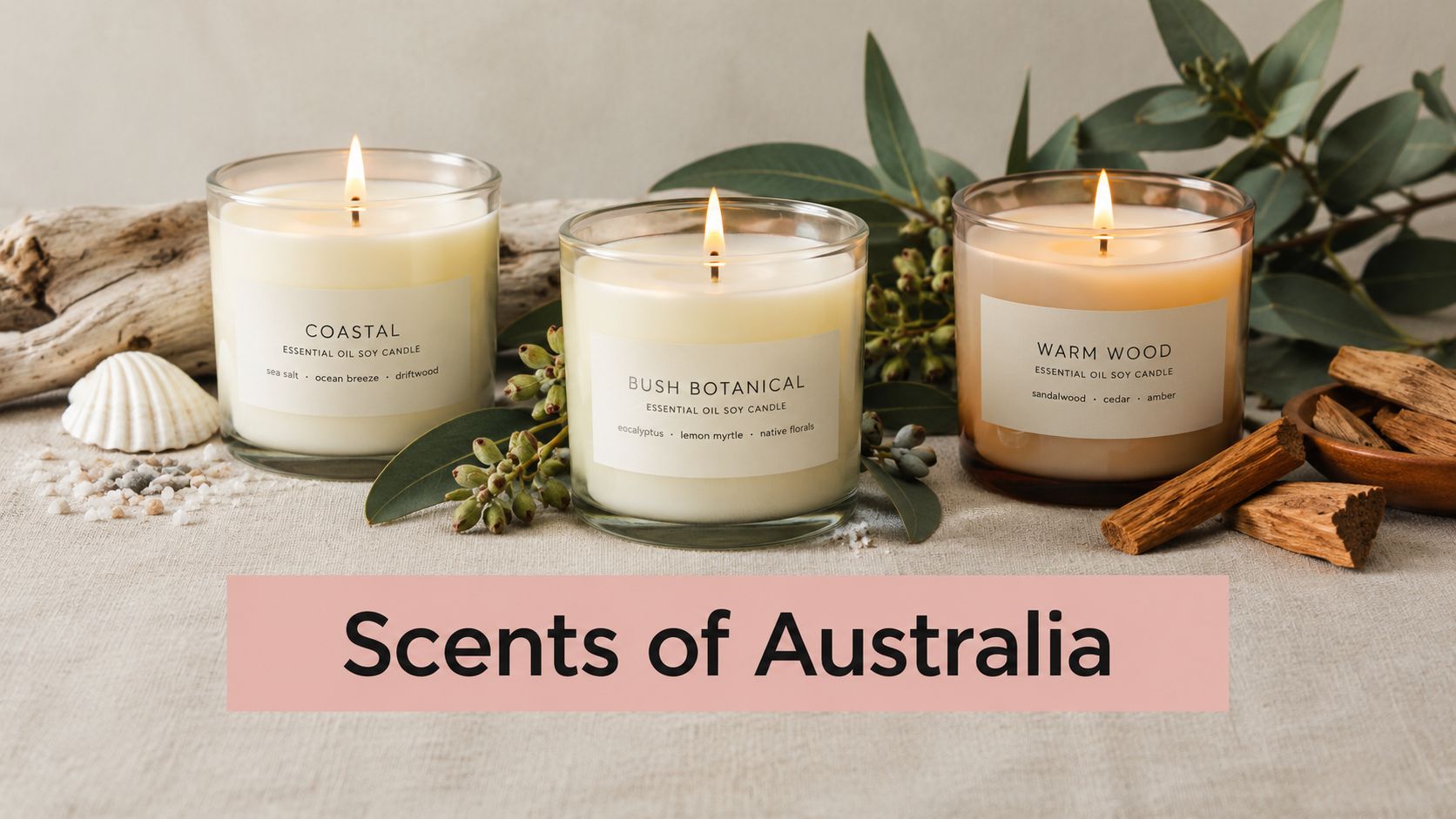
Fresh coastal fragrances suit kitchens, entryways and open-plan living spaces. Look for profiles that suggest clean air, sun-warmed timber and the soft mineral freshness of a beach after the tide has gone out. A coastal candle can make a room feel airy without becoming sharp.
Eucalyptus, sage and bergamot are botanical profiles receiving attention in Australian home-fragrance conversations, as reflected in Australian home-fragrance trend coverage from Artes. They offer different versions of freshness. Eucalyptus feels green and invigorating, sage feels dry and herbal, while bergamot brings a gentle citrus brightness.
For more on the character and use of eucalyptus in fragrance, explore this guide to eucalyptus essential oil.
Bush botanicals and native sweetness
Bush-inspired scents bring the Australian outdoors indoors. Bush Florals & Native Honey suggests golden warmth, flowering scrub and the comforting sweetness of honey gathered somewhere beyond the back fence. Kookaburra & Banksia feels more textural, with a distinctly Australian personality that suits a living room or thoughtful housewarming gift.
Golden Wattle has a sunny, optimistic quality. It's the sort of fragrance that feels at home during spring cleaning, weekend brunch or those bright Queensland mornings when the windows are open and the whole house seems to breathe.
A scent story can be more useful than a note list. Ask yourself whether you want the room to feel serene, invigorating, nostalgic, cosy or grounded, then choose the profile that tells that story.
Warm woods and soft florals
Warm sandalwood, smooth vanilla and deeper woods work beautifully in reading corners, bedrooms and dining rooms after sunset. They create a low-lit, settled feeling, especially during cooler evenings when a glowing candle feels like a small luxury.
Soft florals are gentler when balanced with woods, citrus or musk-like warmth. They can make a bathroom or dressing area feel polished without turning it into a florist's fridge. Let the fragrance sit in the room for a little while before adding another scent, because layering too quickly can muddy the individual notes.
Safety and Sustainability Truths Behind Natural Claims
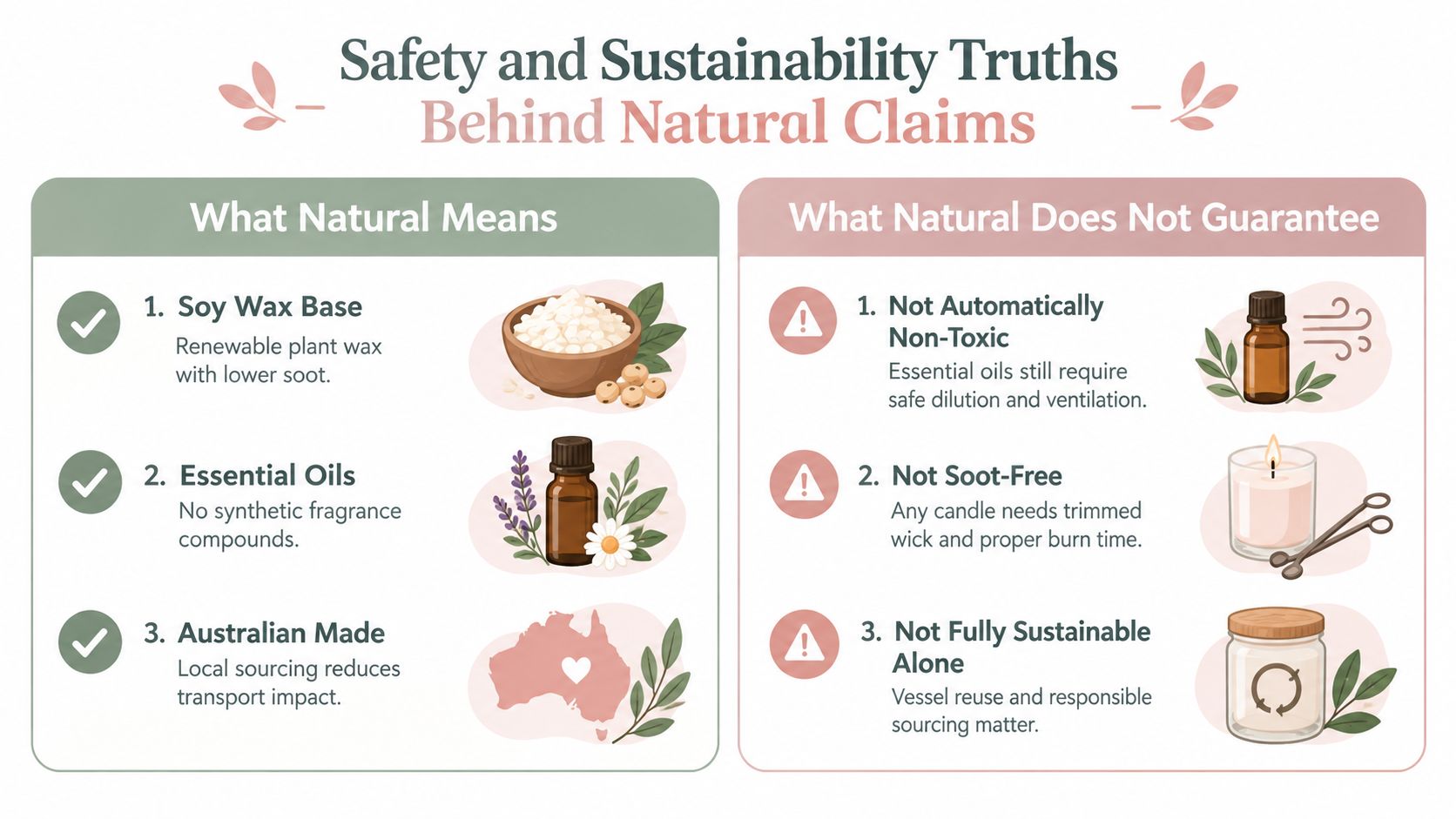
The word natural can make a product sound automatically gentle. In candle-making, that shortcut can cause confusion. Essential oils are concentrated aromatic materials, and a candle still contains a heated fuel system with an open flame. The formulation and the way you burn it matter more than the label alone.
An Australian recall involving an iKOU candle warned that excessive essential oil could allow the wax to catch fire, creating a risk of serious burn injuries or property damage, as described in the official iKOU recall information. That's a clear reminder that essential oils aren't suitable in unlimited quantities.
What clean burning really involves
Independent emissions research cited in candle-industry materials reports very low total VOC emissions for well-made candles across major wax types, including soy. Reference candles recorded TVOC emissions of about 3.07–5.09 micrograms per gram of wax consumed, while closed-room air levels averaged under 2% of the applicable indoor air-quality standard, according to the National Candle Association's research studies page.
Those findings don't turn candle care into a fuss-free free-for-all. A candle can still behave poorly if the fragrance is overloaded, the wick is unsuitable or the room has poor airflow. Clean burn is a result of candle engineering and sensible use, not a reward granted by the word soy.
Ventilation is simple and sensible. You don't need a wind tunnel through the lounge room, but avoid burning a candle in a sealed, stuffy space. If the flame flickers heavily, the wick mushrooms or soot gathers on the vessel, extinguish it, let it cool and reassess the setup.
Natural choices need practical habits
Soy wax offers a plant-based alternative, and Australian-made products can support local making and shorter supply chains compared with fully imported goods. Sustainability also includes the vessel, packaging, fragrance sourcing and what happens after the final burn.
A reusable glass container has a second life as storage for bathroom bits, cotton buds or tiny treasures from the beach. That reuse won't solve every environmental question, but it's a meaningful habit when paired with responsible sourcing and careful production.
Natural is a starting point, not a safety certificate.
Australian fire guidance keeps the everyday rules wonderfully clear. Fire and Rescue NSW advises keeping candles away from curtains and upholstery, extinguishing them before leaving the room or going to bed, and never leaving them unattended. The Victorian fire-safety fact sheet adds stable, non-combustible surfaces, draft-free placement and heat-resistant holders that are large enough to catch melted wax.
How to Choose Quality and Make Your Candles Last
Quality starts before the match. Look for a clear ingredient description, a named wax type, fragrance information and practical care advice. A trustworthy listing should help you understand what you're buying rather than relying on a vague “clean” or “premium” label.
Read the details before buying
For an essential oil soy candle, useful clues include:
- Wax clarity: Look for a stated soy wax base rather than assuming the word “natural” tells you everything.
- Fragrance description: Essential oil-based or botanical fragrance information gives you more context than a generic scent name.
- Wick information: Lead-free cotton wicks and sensible trimming instructions show that the maker has considered burn behaviour.
- Burn guidance: Clear first-burn instructions and a stated burn time make the product easier to use well.
- Vessel details: A stable, heat-suitable container should feel like part of the design, not an afterthought.
A well-made candle should develop an even melt pool rather than leaving a thick ring of unmelted wax around the edges. The flame should look steady, and the wick shouldn't become an oversized black knot. If something looks unusually hot, smoky or unstable, put it out.
Give the wax a memory
The first burn sets the pattern for later burns. Let the melt pool reach the container's edge before extinguishing the candle, otherwise the wax may remember a smaller circle and tunnel down the centre on future use.
Keep the wick trimmed to 2–5 mm, the range recommended in Blushing Ivy's candle-care guidance. Avoid burning in a draught, and don't place the candle near children, pets, curtains, bedding, carpet, furniture or flammable liquids.
The soy candle burn-time guide offers further care context, but your candle's own label should always take priority.
A simple Australian safety checklist
- Choose a firm base: Place the candle on a stable, non-combustible surface.
- Protect the surroundings: Keep it away from windows, open airflow, fabric and clutter.
- Watch the flame: Never leave it unattended, even for a quick dash to the letterbox.
- Extinguish properly: Put it out before leaving the room or going to bed.
- Leave it still: Don't move a candle while it's lit or immediately after extinguishing, because the wax and vessel may be hot.
- Check your alarm: Fire and Rescue NSW recommends testing smoke alarms monthly.
Canberra fire-safety advice adds a particularly useful placement rule. Burning candles should be kept one metre away from furniture, drapes, bedding, carpet and other flammable materials, and they shouldn't sit on windowsills, according to Canberra Government fire-safety guidance.
Gifting and Styling Ideas With Essential Oil Soy Candles
A candle makes a lovely gift because it doesn't demand a particular size, colour palette or personal style. Choose a fresh coastal scent for someone who loves open windows and weekend swims, a bush botanical for the friend with a garden full of natives, or a warm wood profile for the person whose ideal evening includes a book and absolutely no notifications.
For styling, place one candle on a tray with a small vase, a ceramic dish or a stack of books. Keep the composition simple so the flame remains the hero. In a bathroom, pair the candle with a Room & Linen Spray for a quick refresh, or use Fragrance Diffusers when you want a steady scent presence without a flame.
A thoughtful gift pack can combine a candle with a Scented Car Diffuser for the daily commute, especially for someone who enjoys carrying a favourite fragrance from home into the car. For a more masculine taste, the Wild Heath Society range brings deeper scent directions and matte-black presentation.
Blush-pink cylinders, gold details and tidy packaging can make a gift feel finished before you've even found the wrapping paper. For more ideas beyond home fragrance, browse these planet-friendly gift ideas for women, then build a present around the recipient's rituals rather than choosing the prettiest box.
Small-batch Australian-made products also suit boutique retailers and gift buyers who want a story with their shelves and celebrations. A candle inspired by local botanicals feels personal, useful and distinctly connected to place, which is rather lovely whether it's given for a birthday, housewarming, Mother's Day or because someone deserves a little glow.
Blushing Ivy Home Fragrance offers handcrafted soy candles, Australian-made essential oil-based fragrances, diffusers, room sprays, car fragrance and gift sets inspired by beautiful everyday places. Visit Blushing Ivy Home Fragrance to explore scents for your own home or choose a thoughtful Australian-made gift.