

Fragrance Car Diffuser: The 2026 Guide to a Fresh Ride
You climb into the car on a bright Sunshine Coast morning, open the door, and get hit by yesterday's takeaway, damp beach towels and warm upholstery. One little window crack helps, but the smell has already settled into the cabin. A fragrance car diffuser can make the daily drive feel fresher, but only if you choose a format that suits Australian heat, airflow and the materials inside your vehicle.
The car is a tiny enclosed space, not a living room. Fragrance becomes intense quickly, spills can mark plastics and fabric, and direct sun changes how oils, timber, glass and plastics behave. I'm far more interested in those practical details than a glossy promise about scent throw or longevity. The right diffuser should smell beautiful without turning the cabin into a perfume cupboard.
Table of Contents
- Why Your Car Deserves a Fragrance Diffuser Too
- The Main Types of Fragrance Car Diffusers
- Setting Up and Installing Your Diffuser
- Getting the Scent Strength Just Right
- When a Diffuser Is Not the Fix Your Car Needs
- Safety, Heat and Materials in the Australian Climate
- Picking a Scent You Will Still Love Next Month
Why Your Car Deserves a Fragrance Diffuser Too
Australians already understand the pleasure of scenting everyday spaces. Roy Morgan data reported through Australian car air freshener market coverage found that almost one in five Australians aged 14+, about 3.8 million people, bought an air freshener or deodoriser in an average four-week period. That tells us fragrance products are part of ordinary household life, and the car naturally belongs in that habit.
The same data shows the strongest uptake among Australians aged 65+, at 23.9%, compared with 12.3% among under-25s and 16.2% among people aged 25 to 34. I'd read that less as a demographic rule and more as a useful reminder that convenient, low-mess fragrance formats appeal across generations. A small car diffuser can be an easy personal purchase, a practical gift, or a little finishing touch for someone who spends much of the week behind the wheel.
A vehicle also concentrates fragrance in a way a larger room doesn't. Air recirculates through a compact cabin, upholstery holds onto smells, and heat can make a subtle fragrance feel surprisingly bold by lunchtime. That's why I prefer a purpose-built car format over clipping a room product wherever it happens to fit.
My practical rule: Choose the diffuser for the cabin first, then choose the fragrance. A gorgeous scent in a leaky bottle is still a poor car product.
Before buying, check three things:
- Heat stability: Look for housing and containers that can cope with a warm interior.
- Spill control: The product should remain secure while you turn, brake and park on an angle.
- Adjustable intensity: You need a way to soften the scent when the air-conditioning is running or the cabin feels closed.
Australian market coverage points to steady expansion in car fragrance, with one report projecting a 4.5% compound annual growth rate over the next five years, while another records 740 cars per 1,000 people in 2024 as a structural demand driver. Those figures come from Australian car air freshener market trend coverage. Hanging products still account for about 40% of market share in one Australia-focused summary, but the format isn't automatically the best fit for every driver.
The Main Types of Fragrance Car Diffusers
The traditional hanging freshener remains popular because it's simple, visible and easy to replace. A vent clip, however, often gives a more immediate scent because the air-conditioning carries fragrance through the cabin. Neither format wins every time. The best choice depends on whether you want passive scent, direct airflow, quick refreshes or the neatest possible installation.
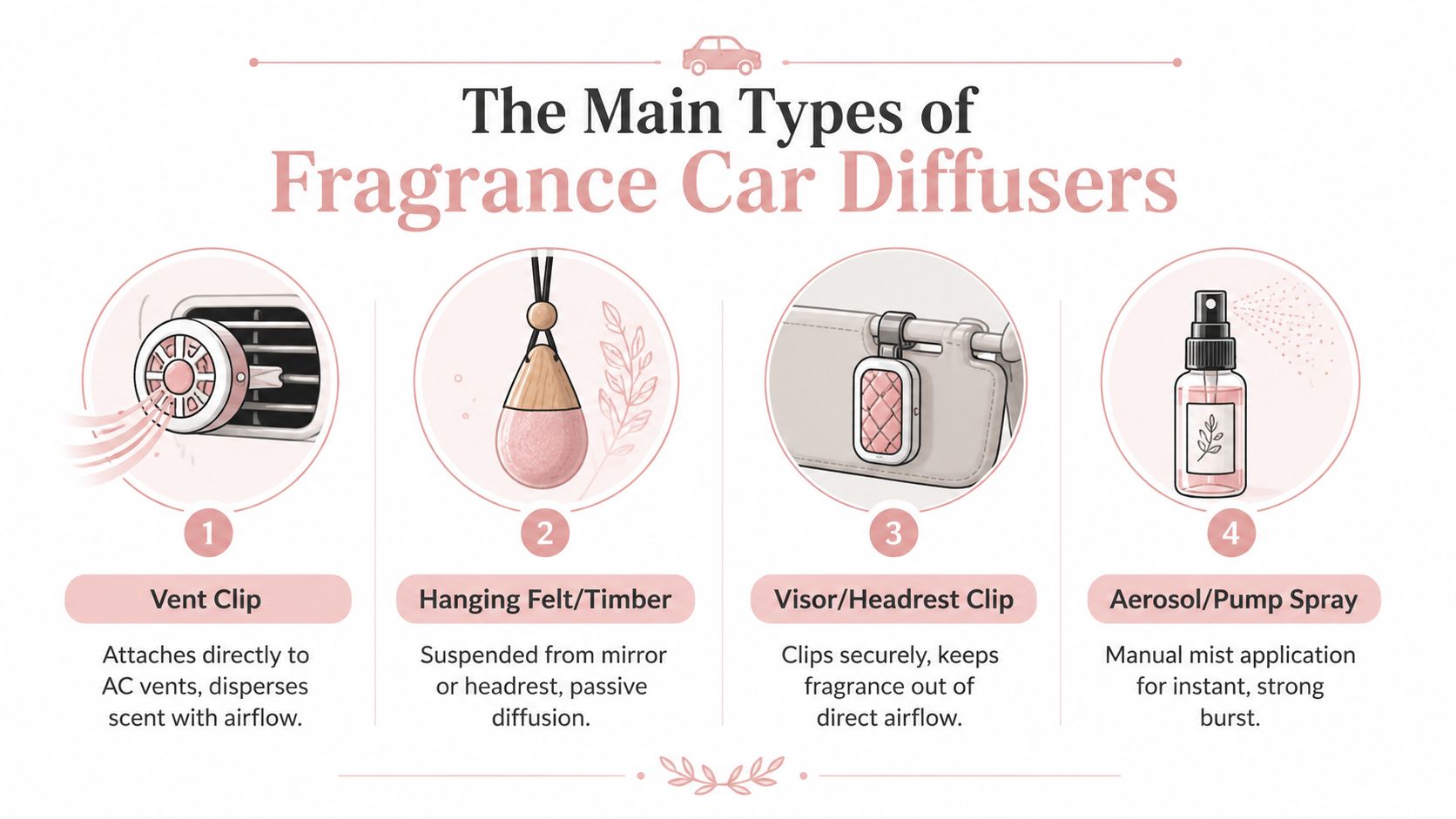
Vent clips
Vent clips attach to the air-conditioning louvres, so airflow does the dispersing for you. They're handy for drivers who want fragrance to appear quickly and who like swapping scents without reaching around the cabin.
The trade-off is intensity. Because the product sits directly in the airflow, it can become too strong in a small cabin. The clip may also compete with the vent itself, and direct sunlight can be hard on housings or scent pads. I'd choose this format for someone who wants a noticeable fragrance during the commute and is happy to turn it down or remove it when the cabin warms up.
Hanging felt or timber
Hanging styles diffuse passively, usually from a scented felt piece, timber lid or small reservoir. They suit weekend cruisers, gift buyers and anyone who likes a visible accessory with a little handcrafted character.
They're gentler than a vent clip, but movement matters. A bottle can swing on rough roads, and over-oiling can stain a headliner or nearby trim. A timber-lid design should hang level and securely, never where it blocks the driver's view. Our guide to a car diffuser for essential oils covers the format in more detail.
Visor and headrest clips
These clips keep fragrance close to the driver or front passenger, away from the direct vent stream. They can work well when the dashboard is crowded or when you want a more controlled position.
Their weakness is visual clutter. A visor clip can compete with sun protection, while a headrest clip may be more noticeable to passengers. Use one if placement control matters more to you than an invisible installation.
Aerosol and pump sprays
Sprays give you an instant burst with no permanent fitting. They're useful after a quick clean, before a passenger arrives, or when you only drive occasionally.
They don't offer ongoing scent in the same way as a diffuser, and the fragrance can feel sharp if you spray heavily into a closed cabin. Use a small amount, ventilate, and never treat spray as a substitute for cleaning.
For a passive timber-and-glass option, the Scented Car Diffuser is an 8ml hanging format with a natural timber lid. The instructions are straightforward, remove the stopper, replace the lid, shake gently, then hang securely. Wipe spills immediately, keep the string and excess oil away from plastic surfaces, and make sure the bottle doesn't obstruct your vision.
Setting Up and Installing Your Diffuser
A good installation prevents most of the annoying problems people blame on the fragrance itself. Start with the bottle, wick or pad, then decide where the product can sit without touching trim, blocking vision or interfering with controls.
Timber-lid diffuser
If you're using a refillable or timber-lid style, inspect the bottle and lid before adding fragrance. The lid should sit securely, and the wick or absorbent section should be clean and properly seated.
Add a very small charge of oil to the wick, then let it absorb before closing the diffuser. Australian guidance from N-Essentials on essential oils for car diffusers recommends starting with a low amount and increasing gradually because essential oils are concentrated, and excess fragrance is difficult to remove once it's applied.
Hang the diffuser level from a secure location such as a headrest strap or suitable grab-handle area. Don't tip the bottle repeatedly to “wake up” the scent. That sends excess liquid into the wick and increases the chance of drips onto the dash, trim or upholstery.
Vent-clip style
For a vent clip, check whether the product attaches directly to the louvre or uses a replaceable pad. Seat it firmly, then adjust the louvre so the airflow isn't blasting straight at your face. If the diffuser has a directional design, align it with the vent fins rather than forcing it across them.
Close the side vents if the fragrance feels uneven. You can also point the airflow away from the driver and use the centre vent to distribute the scent more gently. The aim isn't maximum force. It's a soft, even release that doesn't make the first few minutes of driving uncomfortable.
For more guidance on placement and handling, see Blushing Ivy's article on a car diffuser hanging. Let a new fragrance breathe before making a final judgement. A scent can feel unfamiliar at first, then settle into a much more wearable character once the cabin has circulated it.
Getting the Scent Strength Just Right
A car cabin doesn't need a large oil load. Essential oils and fragrance oils are concentrated, and a closed vehicle can amplify intensity quickly. Start conservatively, take a short drive with some ventilation, and only add more if the fragrance has faded.
Vent clips deserve extra restraint because airflow pushes scent directly into the cabin. I'd begin at the lowest practical setting, or use a smaller scented pad charge than you'd choose for a passive hanging diffuser. A timber style is easier to soften. Move it away from the airflow, reduce the exposed wick, or allow the cabin to ventilate before deciding the fragrance itself is too strong.
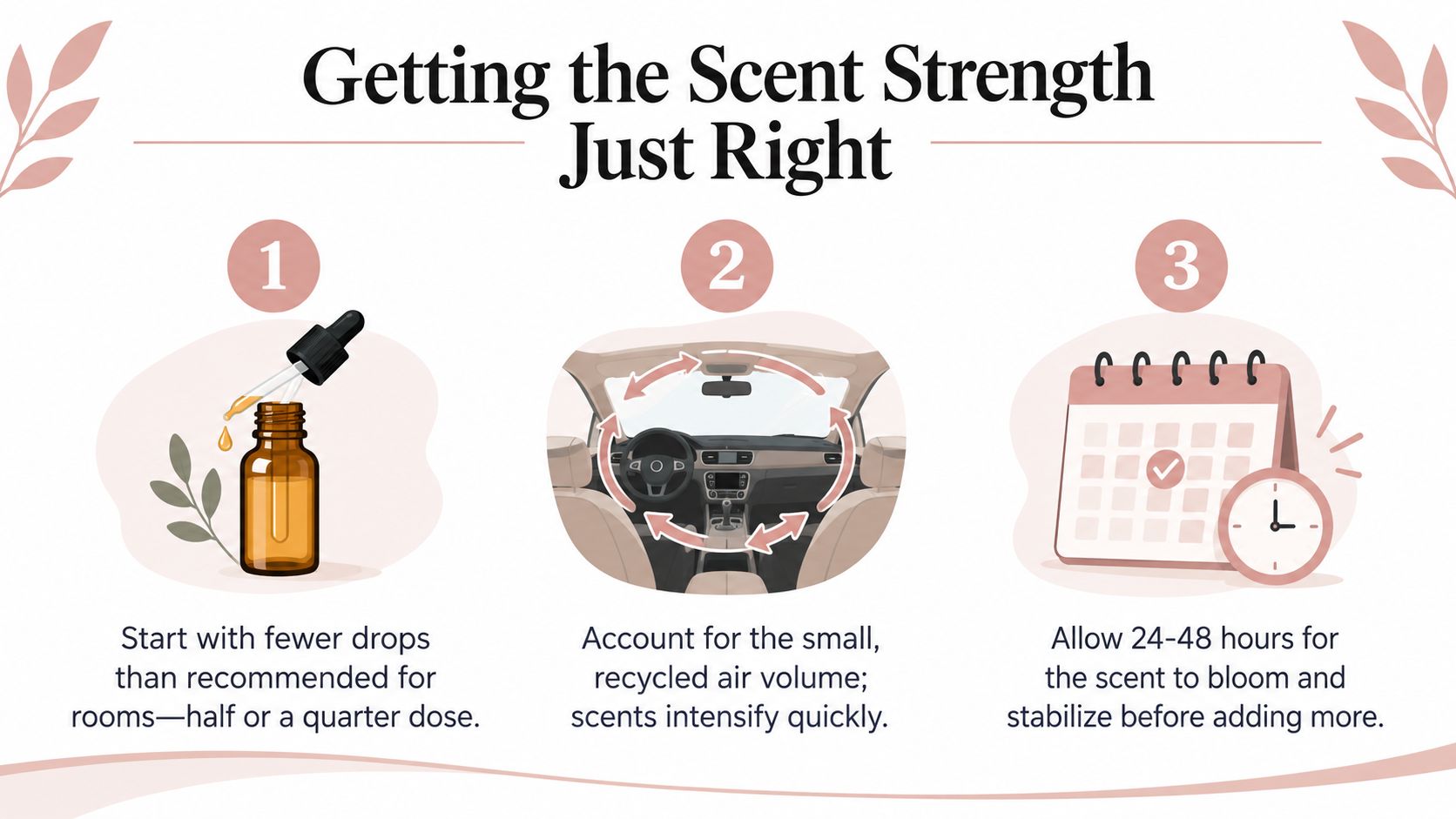
Heat changes the experience. A fragrance that feels restrained on a cool morning can bloom heavily once the interior warms. Crack a window before you discard the diffuser or decide you've chosen the wrong scent. Fresh air often solves what feels like an overpowered formula.
If a passenger develops a headache or the driver feels tired, reduce the fragrance immediately and ventilate the cabin. The answer is less product, not more competing fragrance.
Keep the setup simple:
- Begin lightly. Add less than you think you need.
- Drive and observe. Notice the scent after several minutes, not just at the moment of application.
- Adjust slowly. Add fragrance only when the cabin remains faint after ventilation and normal driving.
Never run fragrance continuously in a sealed, parked vehicle. Expert guidance on chemicals in car air fresheners recommends minimising airborne concentration, using the lowest effective intensity and avoiding constant fragrance in a closed cabin.
When a Diffuser Is Not the Fix Your Car Needs
A diffuser adds fragrance. It doesn't remove the source of a stubborn odour. If your car smells like wet dog, old chips, cigarette smoke or damp carpet, adding vanilla on top creates a layered soup that nobody ordered.
Start with a quick cabin check before buying a stronger product:
- Clear the boot and footwells: Remove gym shoes, food containers, beach towels and anything damp.
- Clean fabric properly: Vacuum seats and mats, then treat embedded food or smoke residue with an appropriate interior cleaner.
- Notice the air-conditioning pattern: If a musty smell becomes stronger when the air-conditioning starts, investigate dampness or the cabin filter.
- Check for moisture: Wet carpets, blocked drainage and trapped water need attention before scenting.
A persistent smell often needs scrubbing, drying or professional detailing. For smoke residue specifically, this resource on removing smoke smell from your car offers a practical cleaning direction rather than another masking product.
A diffuser makes sense after the cabin is clean. That's when it can provide the finishing note, like fresh linen after the windows have been opened or a coastal green fragrance after the seats have been properly aired. It shouldn't be asked to fight mould, dampness or years of smoke on its own.
This approach also saves money. Drivers often keep increasing fragrance strength because the underlying odour keeps breaking through. Cleaning the source first gives a gentler diffuser a fair chance to smell the way it was meant to smell.
Safety, Heat and Materials in the Australian Climate
Queensland heat is not a minor detail. A parked car can become intensely hot, and that affects the container, wick, adhesive, clip and fragrance liquid. Safety guidance for Australian car fragrance products warns that liquids may be flammable, can irritate the eyes and airways, and should be used with ventilation. It also advises keeping fragrance away from textiles, painted surfaces and porous materials. You can read the product safety material at Auto Fragrance Australia.
Use this simple material guide when comparing products:
| Material | Heat Resistance | Best Use | Watch Out For |
|---|---|---|---|
| 316L stainless steel | Suitable for repeated oil contact and resistant to tarnishing | Clip housings and durable diffuser bodies | Confirm the fragrance reservoir is also secure |
| Natural timber | Practical for passive diffusion when kept upright | Hanging lids and absorbent scent surfaces | Excess oil can mark trim, plastics or fabric |
| Amber glass | Useful for containing fragrance and reducing direct light exposure | Small hanging reservoirs kept away from sun | Glass can break if it swings or receives a hard impact |
| Low-grade plastic | More vulnerable to heat, fragrance contact and surface changes | Only where the manufacturer specifies automotive suitability | Oil contact can damage plastics and warmed plastic may release unwanted odours |
An Australian product description for a 316L surgical-grade stainless steel car diffuser highlights its resistance to tarnishing, hypoallergenic character and suitability for contact with oils. That makes stainless steel a sensible choice for a durable housing, especially when your car spends time outside.
Mount a hanging diffuser where it stays level and doesn't obstruct your view. A secure headrest or grab-handle position is preferable to letting a bottle swing across the driver's sightline. Keep sprays, refills and loose bottles away from children and pets, and store them where a spill or chew cannot occur.
For refillable and clip-style products, orientation is part of safety. Car diffuser guidance on upright placement and spill cleanup recommends keeping the diffuser upright and wiping spills immediately. That's not fussy advice. Fragrance oil can damage interior surfaces quickly.
VOC control also deserves a place in your buying checklist. CSIRO-linked APAS documentation places products with 5 to 49 g/L of VOCs in a low category and those above 250 g/L in a high category, as outlined in APAS VOC classification documentation. Look for clear labelling, tamper-resistant packaging and conservative placement directions. Don't assume “natural” means harmless if the product can spill, irritate or be inhaled heavily in a small cabin.
Picking a Scent You Will Still Love Next Month
The first sniff can be misleading. Bright citrus, green tea and airy notes often make a sparkling entrance, while sandalwood, cedar, vanilla and amber decide whether the fragrance still feels comfortable after regular exposure.
Sample a scent over several drives if you can. Ask yourself whether it feels clean or tiring once the novelty wears off. A simple citrus, linen or green profile is often easier to live with daily than a dense blend with many competing notes.

Match fragrance to the drive
For a weekday commute, citrus and green tea can feel bright and tidy without making the cabin heavy. Florals suit short school runs or errands when you want something soft and uplifting. Woody or musky blends create a grounded mood for longer highway stretches, especially when the fragrance includes cedar, sandalwood or amber.
A scent can also carry a sense of place. Think sunscreen and salty air, eucalyptus after rain, warm timber, native honey or a bush-floral garden in late afternoon. Those are the notes that make a car feel personal rather than like a petrol station aisle.
If you enjoy comparing fragrance families before choosing a car scent, this top women's fragrance guide is a useful way to think about floral, fresh, woody and warmer profiles. For more car-specific inspiration, browse car diffuser scents.
Look for transparent information about IFRA-compliant fragrance oils and low-VOC formulation. Those details don't tell you whether you'll love a fragrance, but they're useful quality cues alongside secure packaging, careful placement and sensible intensity guidance.
Blushing Ivy's Australian-made, small-batch fragrance collection includes car scents alongside soy candles, reed diffusers, room sprays and gift options. Its sister Wild Heath Society range leans more refined and woody, with profiles such as smoky, leathery, cedar-led and warm amber styles. I'd choose the scent that matches the way you want the car to feel, then dose it lightly enough that passengers can still enjoy the conversation.
Blushing Ivy Home Fragrance offers handcrafted car diffusers in expressive everyday fragrances, with the Wild Heath Society range for a darker, more polished mood. Visit Blushing Ivy Home Fragrance to browse the car collection, compare scent profiles and find an Australian-made fragrance that makes your next drive feel a little more like your happy place.