
Is Natural Fragrance Safe? What Aussie Shoppers Should Know
You've lit a beautiful soy candle, taken a breath, and then wondered, is natural fragrance safe? It's a fair question, especially when “natural” sounds like a promise of gentleness. The honest answer is more useful than a simple yes or no: safety depends on the ingredients, concentration, freshness, ventilation, product type and your own sensitivity.
A scent inspired by eucalyptus, lemon myrtle or coastal air can make a Sunshine Coast home feel wonderfully fresh. It can also contain naturally occurring compounds that irritate some people. Let's untangle the label language and look at what Australian evidence says, without turning your home into a laboratory or making fragrance sound frightening.
Table of Contents
- When “Natural” Smells Lovely but Feels Confusing
- What “Natural Fragrance” Actually Means in Australia
- Essential Oils, Allergens and the Evidence on Reactions
- Australian Labelling and Regulatory Realities
- Safe Use at Home for Candles, Diffusers, Sprays and Incense
- How to Shop Smarter and Read Labels Like a Pro
- Choosing with Confidence and a Calm Nose
When “Natural” Smells Lovely but Feels Confusing
There's a familiar little moment in many homes. You walk past a hallway diffuser and catch a soft eucalyptus note, or light a freshly poured soy candle and notice the room becoming warmer and more inviting. Then the question arrives: if it's plant-based, could it still bother my lungs or skin?
You're not being dramatic. The natural versus synthetic conversation often makes fragrance sound like a tidy choice between “good” and “bad”, but scent chemistry isn't that simple. A plant-derived fragrance can contain allergens, while a synthetic material may be carefully assessed and used at a controlled concentration. The word on the front of the label doesn't tell you everything that matters.
Australian evidence gives us a sensible reason to take that doubt seriously. A 2018 study found that 98.5% of Australians reported weekly exposure to fragranced consumer products, whether through their own use, someone else's use, or both. The same research found that 33% of the general population reported at least one health problem linked to fragranced products. Among people with asthma, 55.6% reported adverse effects after exposure, compared with 23.9% of non-asthmatics, and 24.0% of asthmatics reported an asthma attack. (Australian study on fragranced consumer products)
Those figures don't mean every natural candle will cause a reaction. They do show why “natural” shouldn't be treated as a universal safety guarantee, particularly for people with asthma, eczema, migraine or chemical sensitivity.
The more helpful question
Rather than asking only whether a scent is natural, ask:
- What's in the blend?
- How concentrated is it?
- Is it fresh and stored properly?
- Will it be used in a small enclosed room or a ventilated space?
- How does your body respond to fragrance?
Terpenes are one reason fragrance descriptions can feel confusing. They're naturally occurring aroma compounds found in many plants, and their structure influences how a scent smells and behaves. If you'd like a little more background, this guide to differences between terpene types explained is a useful companion.
The aim isn't to take the joy out of fragrance. It's to help you enjoy a candle, reed diffuser or room spray with your eyes open, choosing the level and format that suits your household.
What “Natural Fragrance” Actually Means in Australia
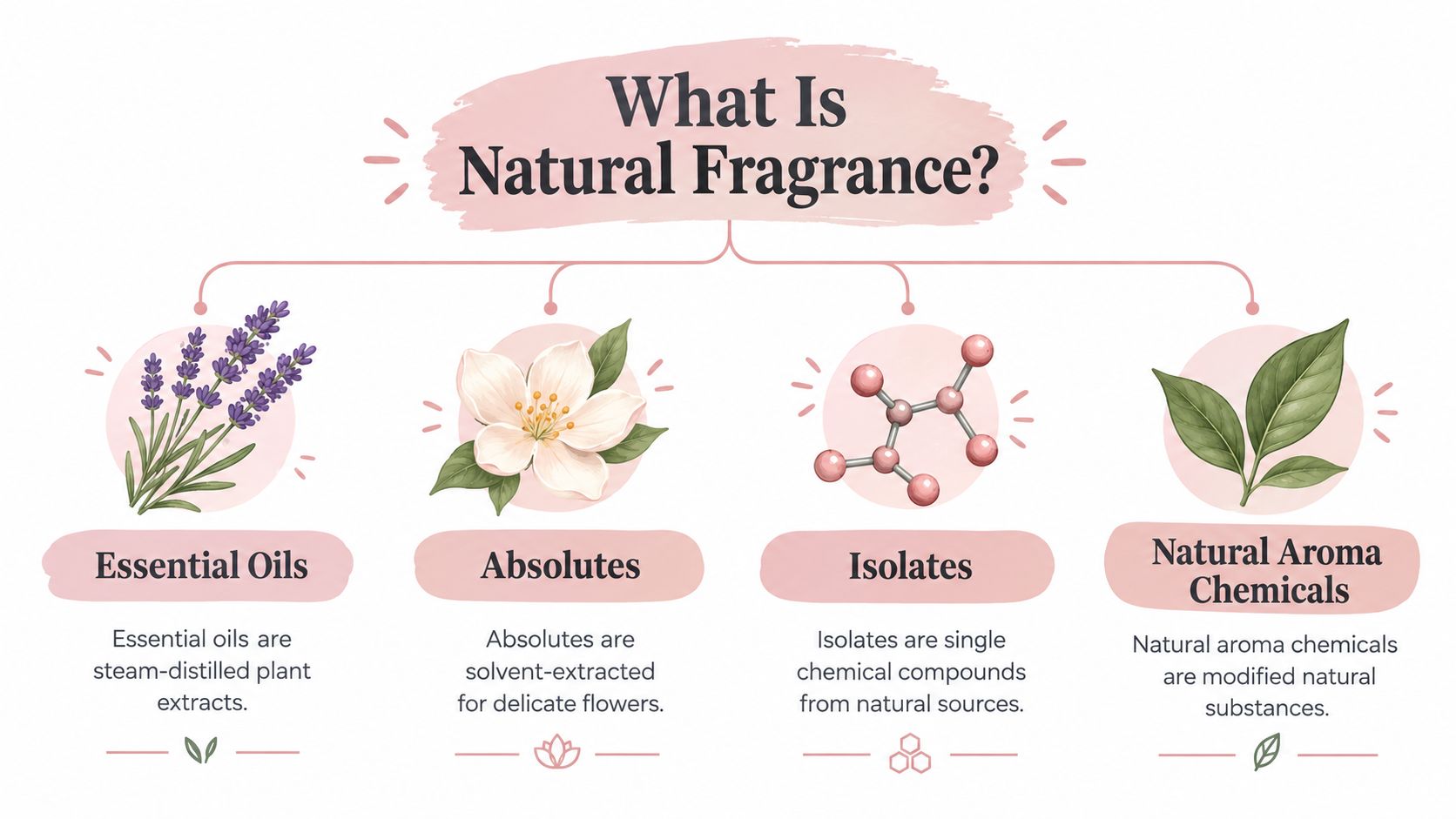
In everyday shopping language, natural fragrance usually means a scent made partly or entirely from plant-derived materials. That might include essential oils, absolutes, isolates and aroma chemicals derived from natural sources. It's often a blend rather than one pure bottle of lavender or lemon oil.
A recipe with many ingredients. Essential oils may provide the bright top notes, an absolute may add floral depth, and an isolate may sharpen one particular character. A maker might combine these materials to create something that smells like warm bush florals, native honey and fresh air rather than a single plant in isolation.
Natural is a description, not a complete safety assessment
Australian shoppers can reasonably assume that “natural” refers to origin, but the term doesn't answer questions about allergen content, oxidation, concentration or intended use. A plant extraction can change chemically depending on how it's produced. AICIS guidance explains that extraction methods such as steam distillation and solvent extraction can affect whether a material is considered naturally occurring for regulatory purposes.
That distinction matters for Australian makers. If a business imports essential oils, fragrance, carrier oils or base ingredients from overseas to mix or blend commercially, it must register with AICIS. If the same materials are bought from an Australian shop, supplier or manufacturer, registration isn't required.
The label can be less revealing than you expect
For Australian cosmetics, fragrance may appear as “fragrance,” “fragrances,” “parfum” or “parfums” under the mandatory ingredient labelling standard. That means a shopper may not see every individual allergenic constituent, even when the scent is plant-derived. The Therapeutic Goods Administration record on fragrance ingredients also notes that repeated exposure can contribute to sensitisation, which is why cumulative contact matters.
Candles and reed diffusers aren't automatically treated like skin-applied cosmetics. Their disclosure requirements can differ from those for creams, soaps or other cosmetic products. That's why a clear, voluntary ingredient or allergen statement from a home-fragrance maker can be more useful than a broad front-of-pack claim.
Essential Oils, Allergens and the Evidence on Reactions
Essential oils are concentrated plant extracts, not harmless drops of “nature”. They contain many aroma molecules, and some of those molecules can irritate or sensitise susceptible people. Common examples include limonene, linalool, citronellol, geraniol and eugenol.
The risk can also change with age and storage. Australian technical guidance identifies oxidised linalool as a strong skin sensitiser, helping explain why an older or poorly sealed essential-oil product may be more reactive than fresh material. Fresh stock, tightly closed packaging and sensible shelf-life controls are practical safety measures, not fussy extras. (Australian fragrance-free guidance)
Australian submissions also report that 18.9% of Australians self-reported chemical sensitivity and 6.5% reported medically diagnosed multiple chemical sensitivity. Among people with MCS, 91.5% reported fragrance sensitivity, while 77.5% said fragranced products had prevented them from accessing places. A South Australian clinical study cited in those submissions found that 82.5% of people reporting chemical hypersensitivity identified perfumes as a trigger. (Australian chemical sensitivity submission)
These findings don't tell us that every scented product is unsafe. They do tell us that fragrance reactions are a meaningful concern for some Australians, especially when exposure is repeated or unavoidable.
Common natural fragrance allergens in Australian products
| Allergen | Common Source | Typical Reaction |
|---|---|---|
| Limonene | Citrus oils, pine and other bright botanical blends | Skin irritation or sensitisation, and possible respiratory discomfort |
| Linalool | Floral oils, lavender-style blends and botanicals | Contact sensitisation, especially after oxidation |
| Citronellol | Rose, geranium and citronella-style materials | Skin irritation or allergic contact reaction |
| Geraniol | Rose, geranium and floral oils | Contact dermatitis or irritation |
| Eugenol | Clove, spice and some warm woody blends | Skin sensitisation and irritation |
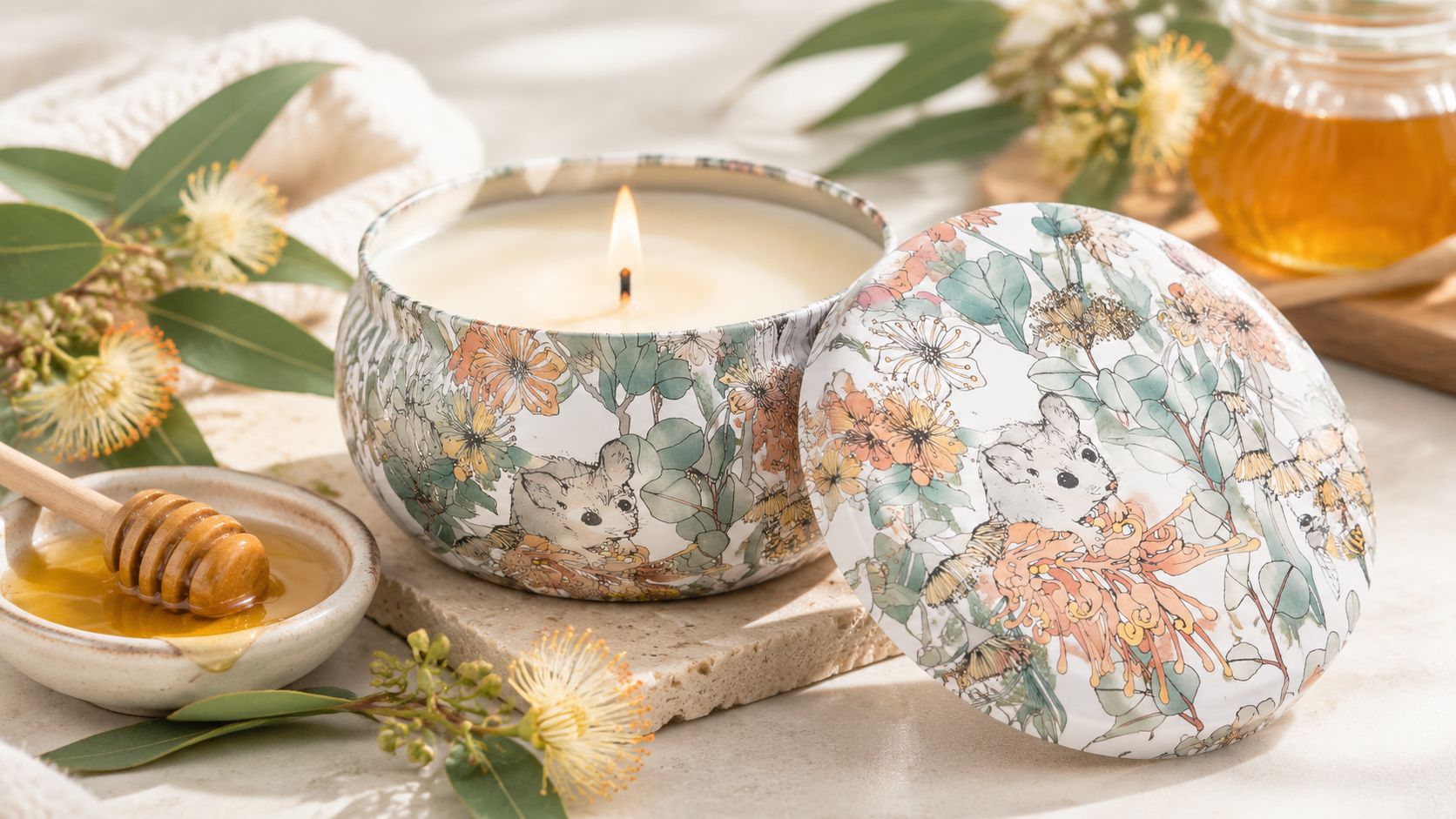
For a product example, Australiana Fairytale Candle - Bush Florals & Native Honey combines lemon and pine needle top notes with eucalyptus and lemon myrtle, grounded by patchouli and sandalwood. Its product information describes a 500 g travel tin, an approximate 35-hour burn time, 100% pure soy wax, Australian-made essential oil-based fragrance, lead-free cotton wicks and candle-care guidance including keeping the wick between 2 and 5 mm.
Citrus deserves extra care around skin because some citrus materials may be affected by UV exposure. Peppermint can be an unsuitable choice around young children, and tea tree shouldn't be applied to broken skin. Those cautions relate to direct or close exposure, so a candle in a ventilated room isn't the same use case as applying undiluted oil to skin.
If fragrance sensitivity is affecting your indoor environment, practical ventilation advice can also help. This resource about Purified Air Duct Cleaning air quality help offers a broader look at managing indoor air concerns. For a plain-language comparison of scent materials, see essential oil versus fragrance oil.
Australian Labelling and Regulatory Realities
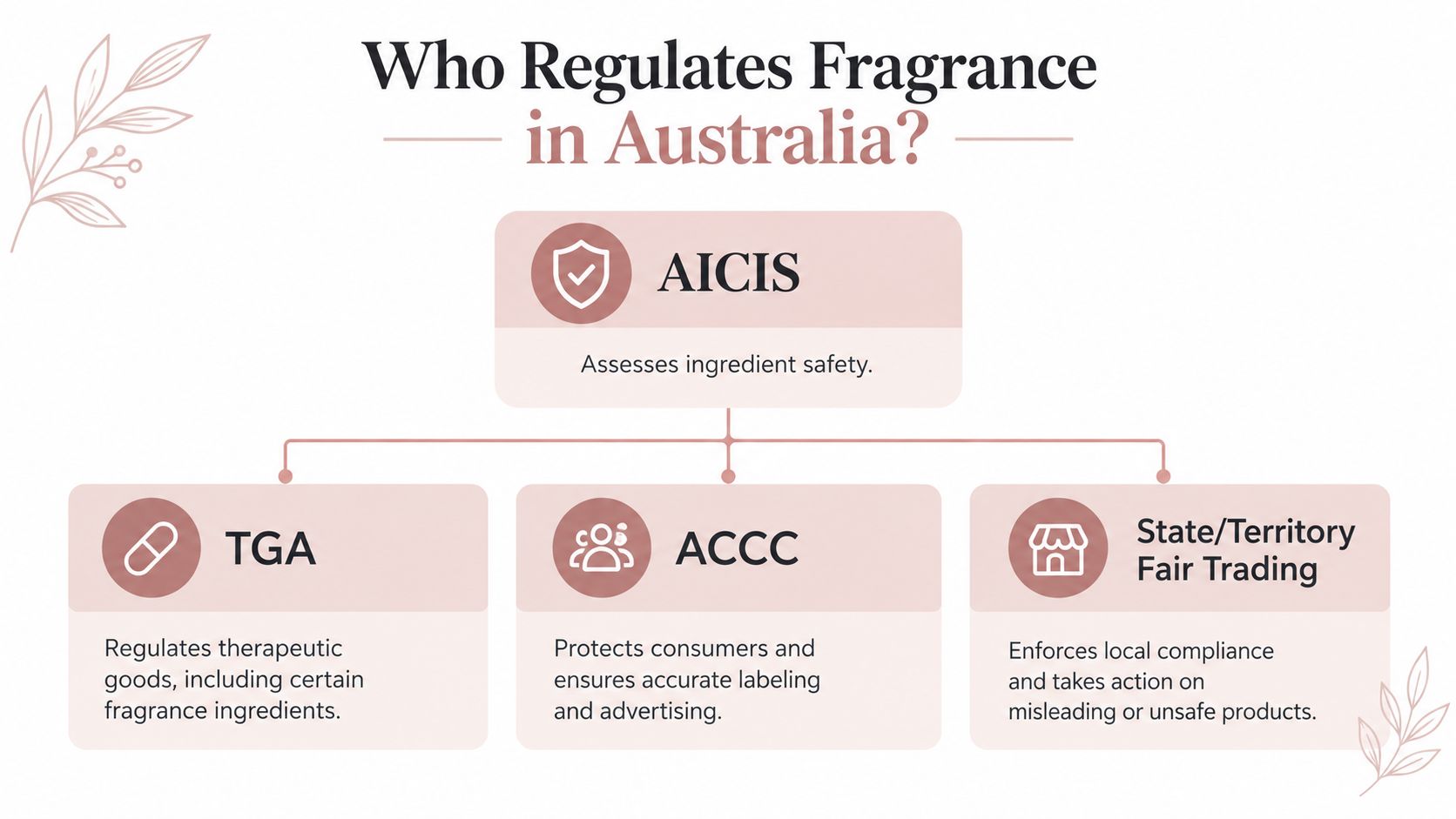
Fragrance safety in Australia involves different responsibilities, depending on what a product is and what it claims to do. AICIS deals with the introduction and regulation of industrial chemicals, while the ACCC oversees consumer protection and relevant product information requirements. Therapeutic goods sit under the TGA, and state or territory bodies can play a role in local compliance and enforcement.
Different products, different rules
A room spray, body product, candle and reed diffuser may look like members of the same fragrance family, but they don't necessarily fall under the same category. Cosmetics have mandatory ingredient labelling rules, while home-fragrance products can have different disclosure expectations. A product that makes therapeutic or health-related claims may also attract a different regulatory pathway.
That creates a practical gap for shoppers. The word “natural” doesn't provide a legal definition of safety on most home-fragrance labels, and “essential-oil blend” can still represent a complex mixture of individual compounds. Australian indoor-air sources also note that there are no current Australian regulatory guidelines setting acceptable VOC concentrations in indoor environments. (Australian indoor-air VOC research)
The same concern appears in an Australian indoor-air submission to the NSW Parliament, which states that full fragrance-ingredient disclosure isn't mandatory on consumer product labels and that Australia has no regulations setting acceptable indoor VOC concentrations. (NSW Parliament indoor-air submission)
What a careful label can tell you
A clear label should help you identify the product maker, intended use and basic safety instructions. If a brand voluntarily names fragrance materials or known allergens, that's useful information, even when the law doesn't require every detail for that product category.
The James Cook University research is a helpful reminder to read beyond reassuring words. In its sample of essential oils, alpha-pinene, limonene and acetone each appeared in more than 70% of the oils, and no ingredients were disclosed on any of the labels examined. (James Cook University essential-oil VOC research)
For a closer look at the way product claims and materials can be discussed in an Australian context, Blushing Ivy's guide to non-toxic candles in Australia is a useful starting point. The practical takeaway is simple: specific information beats a vague promise.
Safe Use at Home for Candles, Diffusers, Sprays and Incense
Dose and ventilation matter more than is widely realised. A light scent in a roomy, airy space is a different exposure pattern from several products running continuously in a closed bedroom. Your own reaction matters too, and no label can overrule a headache, wheeze, rash or feeling of irritation.
Candles
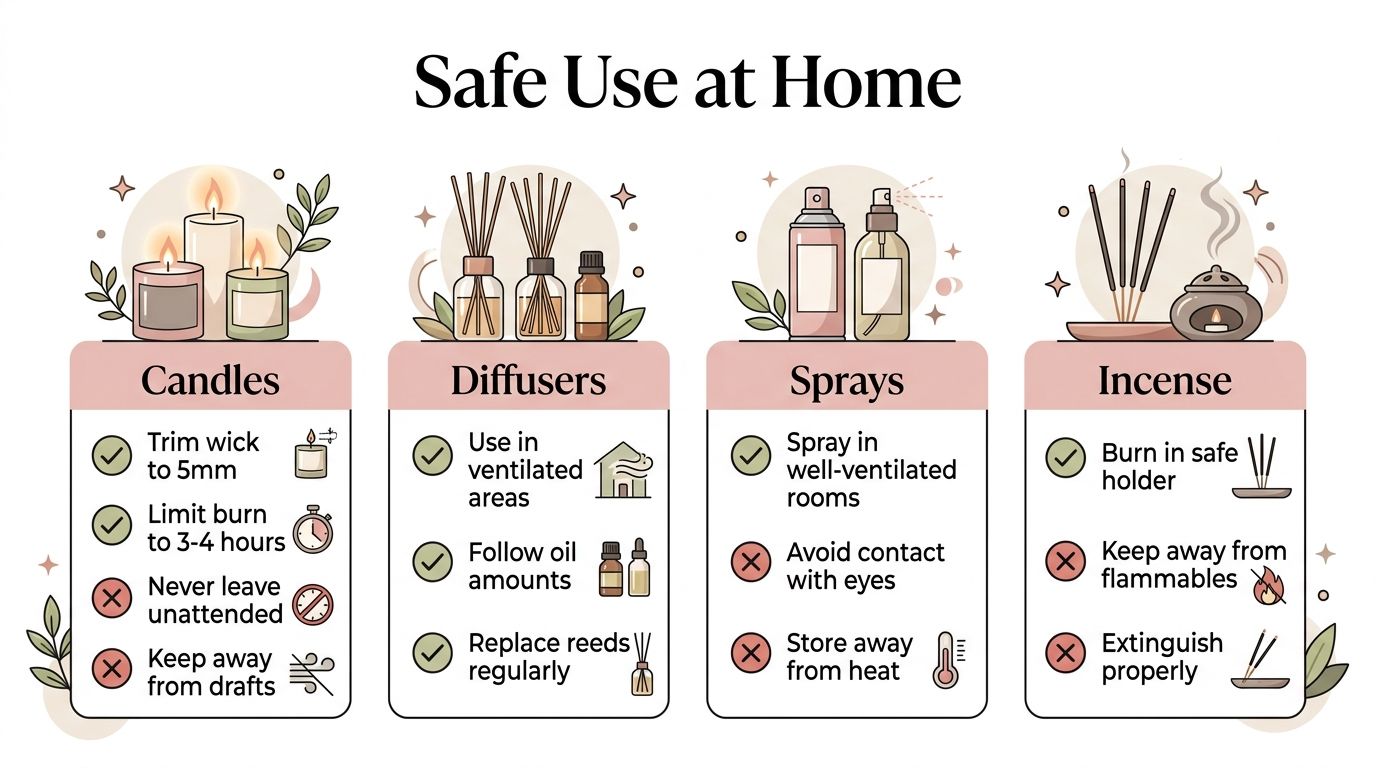
Trim the wick before lighting. Blushing Ivy's candle-care guidance recommends keeping wicks between 2 and 5 mm, which supports a steadier flame and helps minimise soot build-up. Keep candles away from draughts, children and pets, and never leave a burning candle unattended.
Ventilation helps disperse fragrance and combustion by-products. If the scent feels heavy, open a window, move the candle to a larger space or extinguish it rather than trying to push through discomfort.
Reed and ultrasonic diffusers
Reed diffusers provide ongoing fragrance, so placement matters. Choose a ventilated area and avoid positioning one close to someone with asthma or known fragrance sensitivity. Turn reeds according to the maker's directions rather than repeatedly refreshing them when the room already smells strong.
Ultrasonic diffusers need particular care because they disperse fragrance through water and air. Follow the product's oil and water instructions, use short cycles with breaks, and avoid running one continuously in a small, closed room. Keep it away from young children and anyone who notices respiratory symptoms around scented products.
Practical rule: If you can smell several fragranced products at once, reduce the total load before blaming one ingredient.
Room sprays and linen sprays
Spray into the room, not towards your face, and avoid direct inhalation. Keep the bottle away from heat, protect eyes and follow the label directions. For fabrics, test a small hidden area first because fragrance materials and carriers can behave differently on different textiles.
Skin contact is another matter. A product designed for rooms or linen shouldn't automatically be treated as a personal fragrance. If skin exposure is possible, patch-testing and careful ingredient checking are sensible, especially if you have eczema or a history of contact dermatitis.
Incense
Incense creates scent through burning, so smoke and ventilation become central concerns. Use a stable, heat-resistant holder, keep it away from curtains and other flammable materials, burn for a shorter period, and open a window. Stop if the room becomes smoky or anyone develops coughing, headache or irritation.
For gentle, relaxing scent ideas, you might explore this guide to find calming scents for bedtime. You'll find more practical guidance in Blushing Ivy's article on whether reed diffusers are safe.
A short visual reminder can be handy before you light up.
How to Shop Smarter and Read Labels Like a Pro
Front-of-pack language is designed to set a mood. The back panel is where you'll usually find the practical clues. Treat “natural” as an invitation to ask better questions, not as the final answer.
| Label Claim | What It Usually Means | What Shoppers Often Assume |
|---|---|---|
| Natural fragrance | Fragrance materials are described as plant-derived or naturally sourced | The product contains only one gentle, undiluted essential oil |
| Essential oil blend | A mixture of essential oils, sometimes combined with other fragrance materials | Every ingredient is automatically suitable for every person |
| Botanical perfume | A scent built around botanical materials or plant-inspired notes | The formula has no sensitising molecules |
| Fragrance, naturally derived | Aroma materials originate from natural sources, possibly after processing or isolation | The finished scent is chemically simple and non-allergenic |
Common allergens you may encounter include limonene, linalool, citral, geraniol, citronellol, eugenol, coumarin and benzyl benzoate. If you know you react to one, look for it in the available ingredient information and ask the maker how it's handled.
Your quick label check
- Read the back panel: Look for ingredients, safety directions and intended use.
- Find the maker: A country of manufacture, batch information and contact details make follow-up easier.
- Ask about documentation: Some makers can discuss supplier information, fragrance standards or allergen controls.
- Notice the packaging: Refillable formats and sealed containers can support sensible storage and reduce waste.
- Be cautious with “clean” language: A soft-sounding claim doesn't replace ingredient information.
A small business should be able to answer straightforward questions without making you feel awkward. Ask what percentage of the fragrance is used, whether the blend is intended for leave-on skin contact, how it's stored, and whether a pregnancy-safe option is appropriate for your circumstances. If the answer is vague, choose a different format or fragrance.
Choosing with Confidence and a Calm Nose
So, is natural fragrance safe? It can be suitable for many homes when the product is responsibly made and used thoughtfully, but natural doesn't mean non-allergenic. The useful safety questions are about dose, ventilation, product format, freshness and your personal response.
Australian-made soy candles, reed diffusers and incense still need the same sensible care as other scented products. A local maker may also be easier to contact about wax, wick, fragrance materials, storage and intended use. That conversation is often more valuable than a large “natural” claim printed on the front.
At home, keep your ritual simple. Patch-test any product that may touch skin, ventilate rooms, rotate scents so one fragrance isn't running constantly, and stop using a product if you notice headaches, irritation, coughing or breathing changes. If you have asthma, eczema, migraine or known chemical sensitivity, ask your healthcare professional for advice that fits your situation.
Blushing Ivy's small-batch collection includes hand-poured soy candles, Fragrance Diffusers, Room & Linen Spray, Scented Car Diffuser, natural incense and gift sets, with Australian-made, essential oil-based fragrances. The Wild Heath Society range offers a more masculine, refined scent direction, while the Sunshine Coast-inspired collection leans into warm, nostalgic notes that can feel like eucalyptus after rain, salty air and a slow afternoon near the coast.
If you're ready to choose a scent with clear use guidance and a warm Australian-made feel, explore the hand-poured range at Blushing Ivy Home Fragrance. Browse candles, diffusers, sprays and gift sets at your own pace, and get in touch if you'd like help finding a fragrance format that suits your home.