

Reed Diffuser Too Strong: How to Fix the Scent
You know the moment. You open the front door after work, drop your keys, and your reed diffuser greets you from three rooms away like it's hosting its own launch party. Lovely scent? Yes. Subtle? Not even a little.
If your reed diffuser is too strong, don't bin it and don't assume anything's wrong with the product. Usually, the setup is the issue. A diffuser that smells dreamy in a breezy living room can feel like a perfume ambush in a closed bathroom or bedroom. The good news is you can dial it back without wasting the oil, wrecking the reeds, or giving yourself a headache.
Table of Contents
- When Your Reed Diffuser Walks In Before You Do
- Quick Fixes You Can Try This Afternoon
- Why Your Diffuser Is Overachieving
- Longer-Term Fixes for a Smoother Scent
- The Australian Home Angle on Strong Scents
- Prevention Beats Correction Every Time
- Finding Your Scent Sweet Spot
When Your Reed Diffuser Walks In Before You Do
Some diffusers have no indoor voice. They don't gently scent a room. They announce themselves from the hallway, linger in the stairwell, and somehow make the guest bathroom smell like it's trying far too hard.
The signs it's doing too much
A strong diffuser isn't always just a style problem. You'll usually notice the clues pretty quickly:
- Your eyes feel stingy after sitting in the room for a while.
- You get a headache by evening and can't work out why.
- Guests comment on the scent straight away, especially from the doorway.
- The room feels heavy, even if you loved the fragrance when you first opened it.
That last one matters more than people realise. In Australia, indoor air guidance identifies volatile organic compounds, or VOCs, as a major concern, and fragranced products are listed as major VOC sources that shouldn't be used excessively in nonventilated areas. The Australian Building Codes Board handbook also sets a Total VOC benchmark of 500 μg/m³ averaged over 1 hour for indoor environments in its guidance on indoor air quality (Australian Building Codes Board indoor air quality handbook).
Why this matters in a real home
If your diffuser is sitting in a compact bedroom, ensuite, study nook, or apartment entry, “too strong” isn't only about taste. It can also mean the room is trapping fragrance in a way that feels uncomfortable.
Practical rule: If a scent feels overpowering in a small, closed-up room, treat it as an airflow issue first, not a fragrance failure.
That's especially true in homes where windows stay shut, the air con runs often, or the room doesn't get much movement. The fix is usually simple. You need to tune the diffuser like a volume knob, not fight it.
Quick Fixes You Can Try This Afternoon
You want the room to smell lovely, not like the diffuser has taken over the lease. Fix it the same way you'd fix a speaker that's too loud. Turn it down in small steps, then leave it alone long enough to hear the difference.
Start with a reed-by-reed reset
The fastest fix is to reduce the number of reeds. For a small bedroom, bathroom, study, or entry, start low and match the diffuser to the room instead of forcing the room to cope with the diffuser.
Here's the method I recommend:
-
Pull out half the reeds
Put them aside on paper towel or in a small dish. Less exposed reed surface means less oil moving into the air. -
Set a sensible starting point
In a compact room, begin with 2 to 4 reeds, then wait 24 to 48 hours before changing anything (Australian reed diffuser FAQs). -
Adjust one reed at a time
If the scent still barges in before you do, remove one more reed. If it fades too much after a day or two, add one back. That gives you a room-size match, not a guess. -
Stop flipping on autopilot
Flipping ramps the scent up again. If the room already feels heavy, leave the reeds alone for now.
If you want the mechanics behind that, this guide on reed diffuser sticks and how they work explains why a single extra reed can change the whole room.
Move the diffuser, then clear the room
Placement can make a moderate diffuser smell far stronger than it should. Windows, fans, air con, and busy walkways all change how fragrance builds up and where it hits you first.
Do this this afternoon:
- Move it out of direct airflow. Keep it away from open windows, ceiling fan paths, and air-conditioning vents.
- Open the room up for a while. Fresh air helps clear that dense, lingering scent that tends to sit in smaller Australian rooms.
- Pause the diffuser if needed. Remove the reeds for a few hours, then put back fewer than before.
If your home also struggles with stale or heavy air from other sources, a quick read on commercial air purifiers for smoke makes the bigger point well. Air quality problems rarely stay in their lane, and strong fragrance can add to that loaded feeling indoors.
If a standard diffuser keeps overpowering a tiny nook, Mini Fragrance Diffusers are a practical option for smaller spaces. They're 140ml and come with 5 white fibre reeds, which makes it easier to keep the scent controlled from the start.
Why Your Diffuser Is Overachieving
Some diffusers are strong because of the fragrance. Most are strong because of the setup. Three levers do nearly all the work.
Reed count, room size, airflow
Every extra reed gives the oil another path into the air. More surface area means more scent, faster oil depletion, and a room that gets loud very quickly.
Then there's room size. A diffuser that feels soft in an open-plan living area can become a full-blown personality trait in an ensuite.
| Lever | How It Affects Scent | Typical Australian Room Impact |
|---|---|---|
| Reed count | More reeds increase evaporation and scent output | Small bathrooms and bedrooms usually feel stronger sooner |
| Room size | Less air volume means fragrance builds up faster | Compact units, studies, and closed bedrooms can saturate quickly |
| Airflow | Moving air spreads scent unevenly and can intensify it nearby | Fans, vents, open windows, and air con can make one corner smell much stronger |
Flipping habits matter too
For reed diffusers, airflow and room size also affect how often flipping makes sense. A practical guide is roughly every 3 to 4 days in large or drafty spaces and every 10 to 14 days in smaller spaces. Daily flipping makes the scent stronger and uses the oil faster (reed diffuser care guide on flipping frequency).
If your diffuser is too strong, stop treating flipping like a maintenance chore. It's an intensity boost.
Sometimes the room is the real culprit
People get stuck. They blame the bottle when the room is sealed up, sunny, or sitting under an air-conditioning stream. Even a nice fragrance turns bossy in that setup.
If you're trying to work out whether the smell in your home is fragrance overload or something else entirely, this explainer on what causes chemical odor at home can help separate the possibilities.
Longer-Term Fixes for a Smoother Scent
You should not have to keep “fixing” your diffuser every second day. A good setup holds steady, suits the room, and does not leave the air feeling heavy.
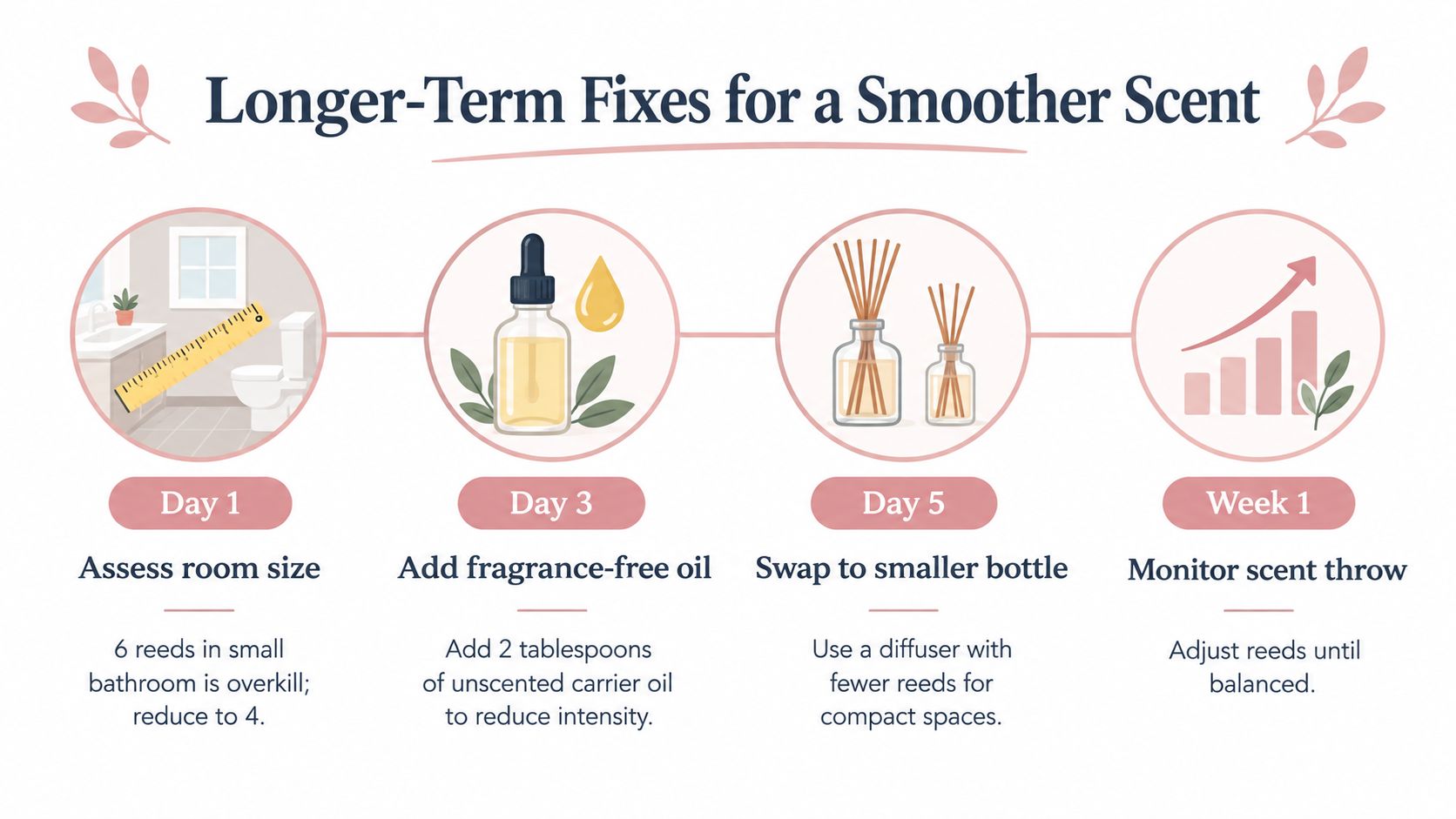
Match the reeds to the room
Start with the reeds, not the flipping.
If your diffuser is too strong, the bottle is usually putting out more fragrance than the space can comfortably handle. That is a comfort problem, and in a closed-up room it can also become an indoor-air-quality problem. Stronger is not better if the room feels stuffy, sleep gets disrupted, or someone ends up with a headache.
Use a simple reed-by-reed reset:
- Small bathroom, ensuite, study, or bedroom: start with 2 to 4 reeds
- Average bedroom or home office: start with 4 to 5 reeds
- Larger living area or open-plan space: start with 6 to 8 reeds
Then leave it alone for 48 hours. If the scent still barges in before you do, remove one more reed. If it disappears completely, add one back. That is how you find the room's actual sweet spot instead of guessing.
Build a steadier routine
Consistency wins here. Constantly changing everything at once is how people end up swinging from “barely there” to “who knocked over the perfume counter?”
A calmer routine looks like this:
- Set the reed count first and keep it there for a few days
- Flip only when the scent has clearly faded
- Keep the bottle out of hot, bright spots
- Wipe drips straight away and keep the diffuser stable, especially around children and pets
Using fewer reeds is also the easiest way to slow oil use without fussing over the bottle all week. If you want a practical baseline for lifespan, this guide on how long reed diffusers last helps you work out whether the diffuser is burning through oil too fast for the room.
Sometimes the room itself is the cause
A strong diffuser is not always a diffuser problem. A sealed room, direct sun, or air con pushing scent into one corner can make even a nice fragrance feel sharp and overdone.
If the air in the room smells “chemical,” stale, or irritating rather than just fragrant, do not shrug it off. This explainer on what causes chemical odor at home can help you separate diffuser overload from a broader air issue.
Your diffuser should sit in the background and make the room feel fresh, not announce itself like a guest who brought a karaoke machine.
The Australian Home Angle on Strong Scents
Australian homes don't all breathe the same way. An older Queenslander with breezes rolling through is a different beast from a newer, tighter home with closed windows and air con humming away.

Strong scent can be more than preference
Australian research on fragranced consumer products found that 33% of Australians experienced health problems such as migraine headaches or asthma attacks when exposed to fragranced products, and 7.7% had lost workdays or a job because of illness linked to fragranced-product exposure (Australian fragranced products study).
That's a big reason I don't brush off strong fragrance as “just being fussy”. For some people, it affects comfort and function.
Australian indoor air guidance also says fragranced products are major VOC sources, and reducing or stopping scented products plus ventilating well can help lower exposure (Your Home indoor air quality guidance).
What this means at home
If someone in your household is scent-sensitive, sleeps lightly, or gets headaches easily, your answer might not be “flip fewer reeds”. It might be “this room shouldn't have continuous fragrance at all”.
For more on that side of things, this guide on are reed diffusers safe is a useful next step.
Prevention Beats Correction Every Time
You will save yourself a lot of fiddling if you set the diffuser up properly on day one. A reed diffuser should suit the room, not take it over.
Start with the room size, then match the reed count to it. In a small bedroom, ensuite, or study, begin with 2 to 4 reeds. In a medium room, try 4 to 6. In a larger open-plan space, you can go higher if the scent still sits in the background after a day. That reed-by-reed approach works far better than stuffing in the full bundle and hoping it calms down later.
Placement matters just as much. Airflow makes a diffuser burn through oil faster and throw scent harder, so keep it away from air-conditioning vents, pedestal fans, and windows that stay open. Heat does the same thing. Sunlit sills look lovely, but they are a terrible place for a diffuser.
A simple setup rule helps. Put the bottle where people pass through the scent, not where they sit in it for hours.
A few prevention habits make a real difference:
- Start lower than you think you need. Adding one reed is easy. Fixing an overpowering room is annoying.
- Match the diffuser to the room's job. Bedrooms need restraint. Entryways and larger living areas can handle more presence.
- Give it a full day before changing anything. Fresh reeds can take time to settle, and early over-correcting usually creates the problem you were trying to avoid.
- Choose a stable surface. Less chance of spills, stains, and a house that smells like a tipped perfume counter.
Safety belongs in the same conversation. Keep diffuser oil out of reach of children and pets, avoid skin and eye contact, and clean spills quickly. Concentrated fragrance oils are not something you want on timber, stone, or little hands.
Done properly, prevention keeps the scent comfortable, the room liveable, and the indoor air a bit easier on everyone. That is the goal.
Finding Your Scent Sweet Spot
There's no prize for running your diffuser at full tilt. The sweet spot is when the room smells welcoming, calm, and put together. Think soft background mood, not department-store fragrance counter.
A simple rhythm that works
My favourite routine is a Sunday check-in:
- Look at the reed count
- Notice the room itself
- Decide whether it needs less, more, or a new spot
Scent is personal. One person's “just right” is another person's “please open a window”. That's normal.
If you like seasonal inspiration for changing the mood of a room without overloading it, these Christmas aroma ideas for your home are a fun example of how people shift fragrance with the season rather than cranking up intensity.
The main thing is this. A reed diffuser that's too strong usually isn't a lost cause. It just needs a little tuning, a bit of airflow, and less enthusiasm from the reeds.
If you're looking for Australian-made home fragrance that's designed to be lived with, not battled with, Blushing Ivy Home Fragrance offers handcrafted scents from the Sunshine Coast across diffusers, candles, sprays, and gift sets. If you're unsure what will suit your room size or you've got a sensitive household, have a browse or get in touch and we'll help you find a softer, better-balanced fit.