

Scent Throw in Candles: Your 2026 Guide
You light a beautiful candle, settle onto the sofa, and wait for that gorgeous fragrance to drift through the room. Twenty minutes later, you're leaning over the jar wondering whether your nose has gone on holiday. It's a familiar little disappointment, especially in an open-plan Queensland home where air-conditioning, ceiling fans and open windows can whisk fragrance away before it reaches you.
That's why scent throw in candles isn't just a matter of adding more fragrance. Room size, candle weight, wax, wick, burn habits and ventilation all shape the experience. Let's make sense of it together, so your next candle feels as lovely in the room as it did when you first opened the box.
Table of Contents
- What Scent Throw Actually Means
- The Science Behind a Strong Fragrance Throw
- Matching Candle Size to Your Room
- Candle Care Habits That Boost Scent Throw
- When Strong Scent Throw Comes at a Cost
- What to Look for When Buying Candles for Reliable Throw
- Your Scent Throw Checklist for Every Candle
What Scent Throw Actually Means
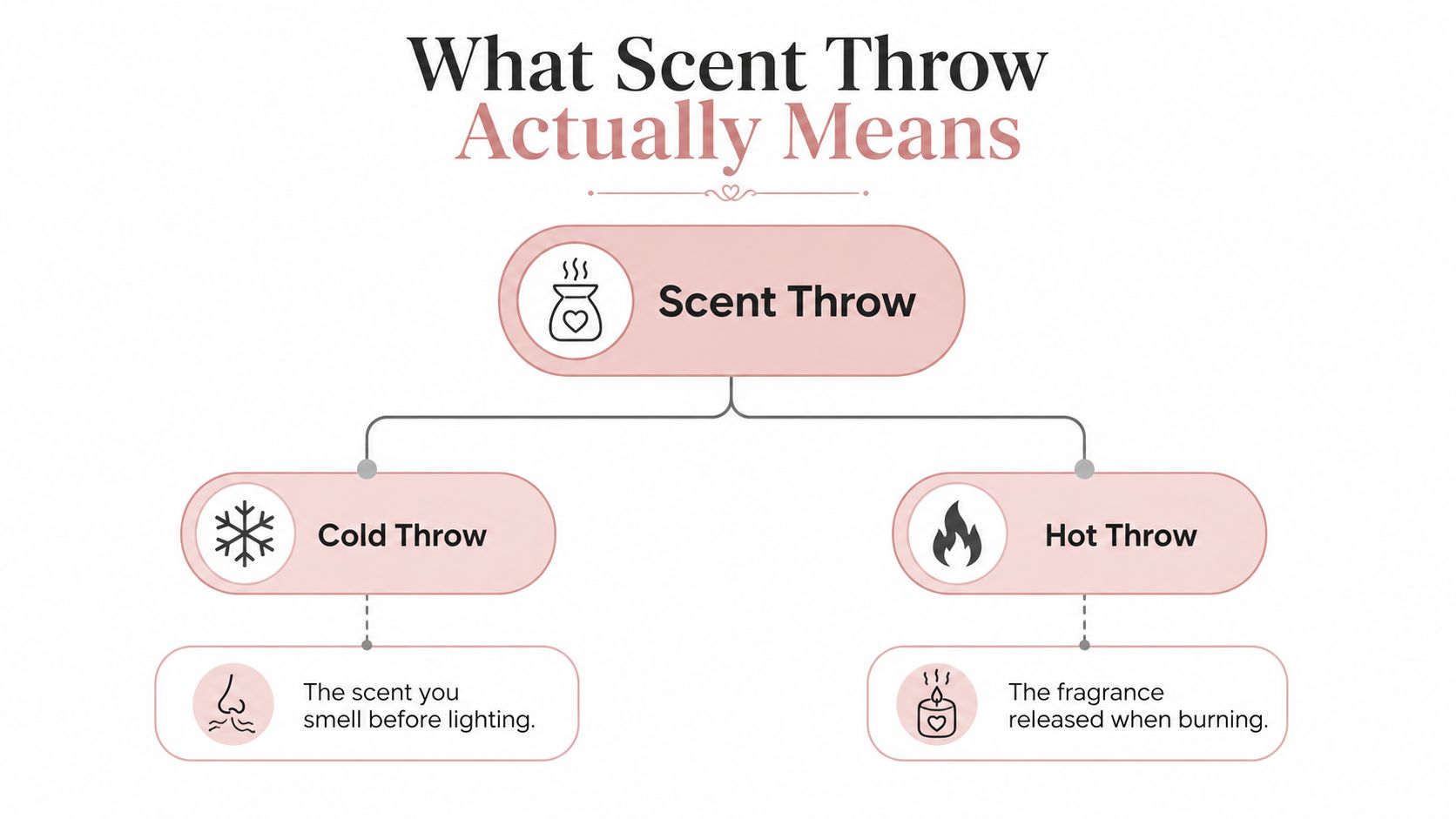
Scent throw describes how a candle releases fragrance into the surrounding air. It has two parts, and they tell different stories.
Cold throw is the scent you notice before lighting the candle. It's the first impression when you lift the lid or walk past the jar. A candle with a beautiful cold throw might smell like warm native honey, soft florals and sun-baked timber, with the cosy promise of a winter evening tucked inside the glass.
Hot throw is the fragrance released while the candle burns. Once the wax melts and a pool forms around the wick, heat helps fragrance travel into the room. This is the part you're really judging when you want a candle to scent your living room, bedroom or study.
Why the two throws feel different
Think about a fragrance such as Kookaburra & Banksia. The unlit candle may offer a quiet glimpse of Australian bushland, perhaps dry banksia, leafy green notes and a gentle floral warmth. Once it's burning, the scent can feel rounder and more atmospheric, like stepping onto a verandah after rain while the evening air carries the garden indoors.
Cold throw helps you choose a fragrance you'll enjoy. Hot throw shows how that fragrance performs in your actual space. A strong cold throw doesn't guarantee a powerful hot throw, and a subtle unlit scent may become beautifully present once the melt pool develops.
A quality candle should feel balanced rather than aggressively perfumed. If you can only smell it with your nose over the jar, the candle may be too small for the room, affected by airflow, or not yet burning in a way that releases its fragrance evenly.
The Science Behind a Strong Fragrance Throw
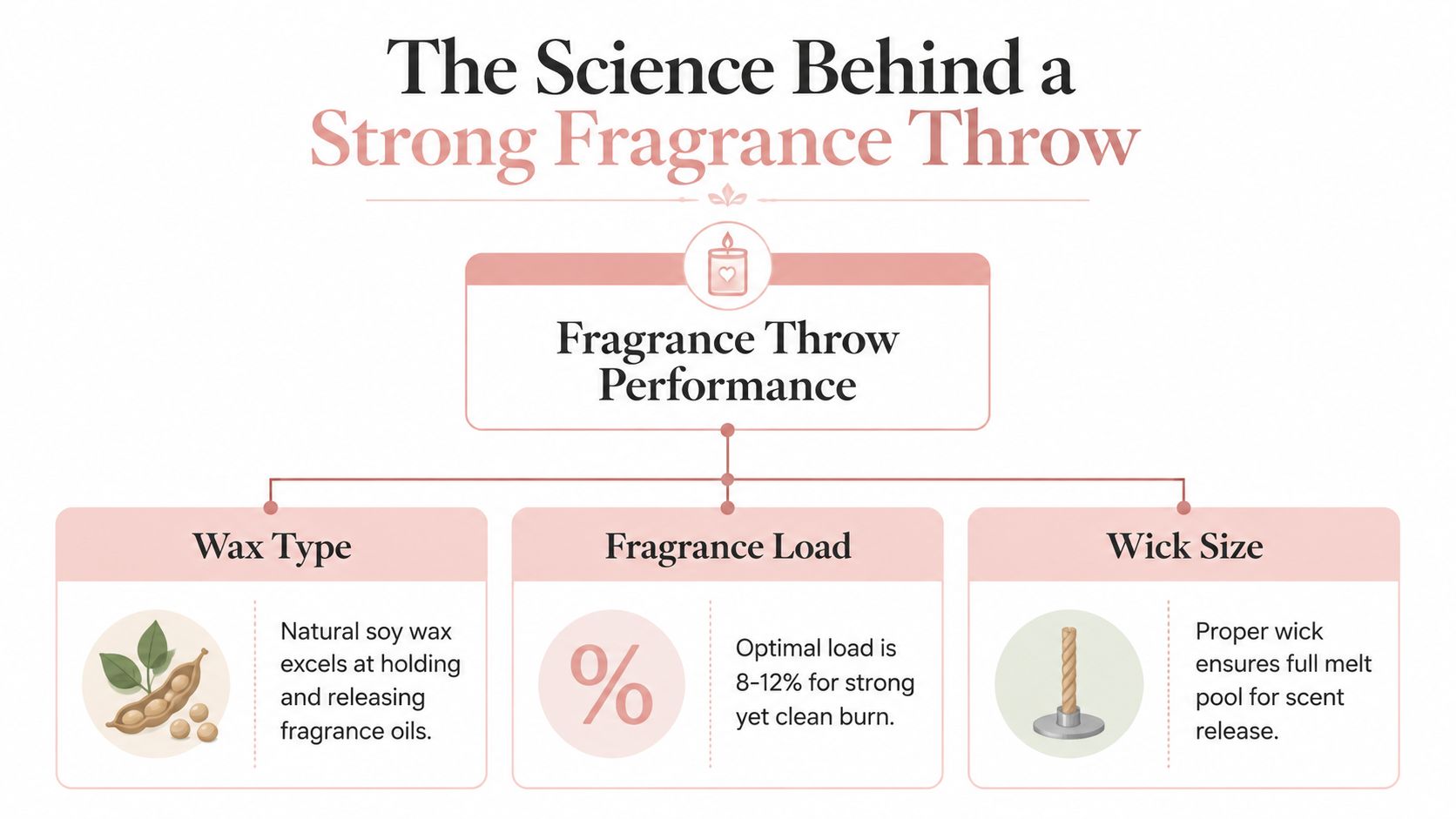
A candle's performance comes from several parts working together. Wax holds the fragrance, the fragrance load determines how much is present, and the wick creates the heat needed to release it. Change one part and the whole burn can change with it.
Wax and fragrance load
Blushing Ivy uses 100% natural soy wax, which holds and releases fragrance gradually during a clean, steady burn. You can learn more about the differences between wax types in this guide to soy wax and paraffin wax.
Australian candle guidance commonly places fragrance load around 6% to 8% for most waxes, according to Australian candle supplier guidance. A frequently used stronger starting benchmark is around 10% by wax weight, or 100 grams of fragrance oil per 1,000 grams of wax, as described by eroma's Australian fragrance guide.
That doesn't mean more oil automatically creates a bigger scent. Australian candle-making guidance explains that different waxes can perform strongly at different loads, so the pairing matters more than chasing a larger percentage. Too much fragrance can upset the balance, affect the burn and release unevenly.
The wick is the volume dial
The wick controls the melt pool, and the melt pool controls how much fragrance can escape. A wick that's too small may leave unmelted wax around the sides, trapping fragrance in the solid wax. A wick that's too large can burn too hot, create soot and use fragrance faster than you'd like.
Australian wick guidance links wick choice to the container's burn diameter. For example, a 36 mm burn diameter is paired with CDN 3, while a 55 mm to 60 mm diameter may pair with VRL 11 or CDN 10, according to this Australian wick sizing guide.
Blushing Ivy candles use lead-free cotton wicks, soy wax and Australian-made, essential oil-based fragrances. The Classic Soy Candle is a 400 g candle made with those materials, and its care guidance recommends keeping the wick between 2 mm and 5 mm for effective burning and reduced soot build-up.
Practical rule: A reliable candle maker tests the wax, fragrance and wick as a combination. The label alone can't tell you how the finished candle will behave.
Matching Candle Size to Your Room
A candle may be well formulated yet seem faint in a large, airy space. A small bedroom, enclosed bathroom and breezy open-plan living area place very different demands on scent throw. In Australian homes, room volume and ventilation often change the result more than fragrance load alone.
For smaller, contained rooms, an 235 g candle can suit bedrooms, bathrooms and studies, while 370 g is suggested for large bedrooms, kitchens and small living spaces in this Australian candle sizing guide. Another Australian guide places 200 g to 350 g candles in many living rooms, with 350 g to 600 g better suited to larger living rooms and open-plan areas. Its room-based recommendations appear in this Australian candle size guide.
| Room Type | Recommended Candle Weight | Best For |
|---|---|---|
| Small bedroom, bathroom or study | 235 g | A more contained space |
| Large bedroom, kitchen or small living area | 370 g | Rooms with more air volume |
| Most living rooms | 200 g to 350 g | Everyday enclosed living spaces |
| Large living room or open-plan area | 350 g to 600 g | Larger connected spaces |
Match the candle to the airflow
The 8-10 Rule suggests using a 226 g candle for every 3 metres of room radius, according to the same Australian fragrance-sizing guidance. Use that as a starting point, then consider how your home behaves. A closed bedroom holds fragrance differently from a room connected to the kitchen, hallway and alfresco area.
Open-plan homes have more air to scent, so a larger format may perform more consistently. You can also position more than one fragrance source in separate areas, rather than expecting one candle to cover the entire connected space. A guide to 3-wick candles explains how multiple wicks can create a wider melt pool across a broader vessel.
Air-conditioning changes the path fragrance takes. Recirculated air may carry scent into nearby parts of the home, while a strong vent can dilute it or move it away before the fragrance builds. Apartment conditions can create the same effect. A smaller candle may feel present in an enclosed bedroom, then seem to disappear in a combined living and dining room with more air movement.
Candle Care Habits That Boost Scent Throw
A candle can have a well-balanced fragrance and still underperform if its first burn is rushed or its flame is exposed to a draught. Good care helps the wax melt evenly, so more of the fragrance can warm and move through the room.
Give the first burn a fair chance
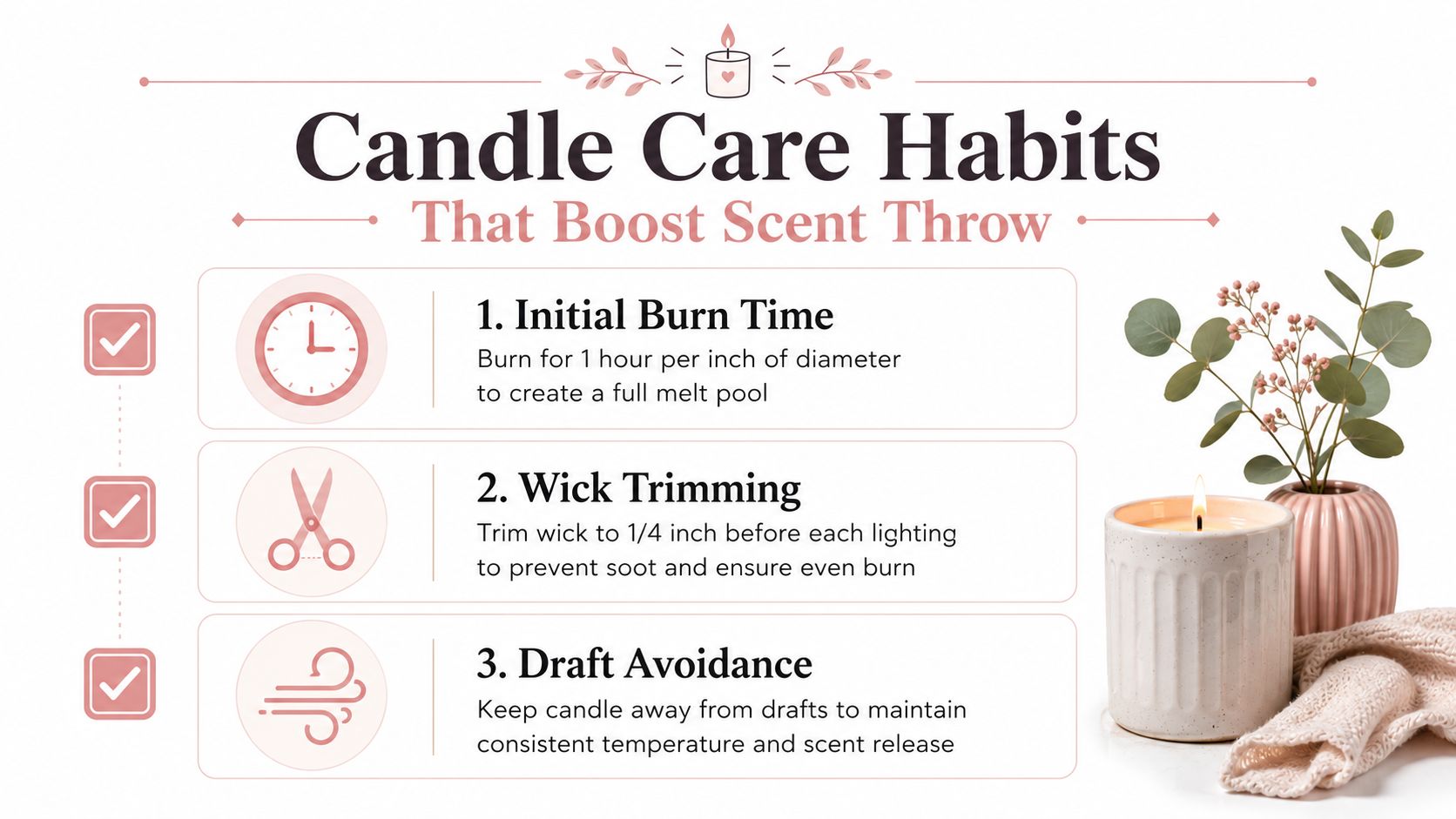
During the first burn, let the melt pool reach the container's edge. This teaches the wax to melt across the full surface. Extinguishing the candle while only the centre is liquid can leave a thicker ring around the sides, reducing the area available for fragrance release on later burns.
Short burns create a similar problem. The melt pool may not have time to develop, so the hot throw seems weak before the candle has had a proper chance to perform. In an Australian home, this matters even more when a larger living area or open-plan layout already gives the fragrance more air to fill.
Keep the wick tidy
Trim the wick before each burn, aiming for around 4 mm to 5 mm. Blushing Ivy's care advice allows 2 mm to 5 mm, so the practical goal is a neat, controlled flame rather than a tall, smoky one.
A trimmed wick supports a steadier burn and helps minimise soot. For a closer look at the tool and technique, see this candle wick trimmer guide.
Protect the fragrance from moving air
Place the candle away from air-conditioning vents, open windows, ceiling fans and busy draughts. Moving air can disturb the flame, reshape the melt pool and carry fragrance away before it settles. In an apartment, recirculated air may move scent into another area, while a strong vent can make the candle seem quieter in its original room.
This short candle-care video is handy if you prefer to see the basics in action:
A calm flame usually gives you a calmer, more even fragrance experience.
Never leave a burning candle unattended. Keep it away from children, pets and anything that could catch fire.
When Strong Scent Throw Comes at a Cost
The strongest-smelling candle isn't automatically the best choice for every home. Fragrance performance should sit alongside comfort, ventilation and the needs of anyone who shares your space.
Australian evidence summarised by the NSW Parliament's indoor-air evidence document notes that burning candles can release PM2.5, ultrafine particles, VOCs, PAHs, aldehydes and NOx, and that scented candles can increase particulate concentrations indoors. The same evidence summary cites fragrance sensitivity at 32.2% across the US, Australia, Sweden and the UK.
That doesn't mean you need to banish every candle to the back of the cupboard. It means a powerful throw deserves a little thought, particularly in a small apartment, a closed bedroom or a home where air-conditioning keeps indoor air circulating.

Choose presence over overload
Start with a candle suited to the room rather than trying to overpower a large space with a small jar. Burn it in a well-considered location, keep the wick maintained and allow fresh air into the room when appropriate.
For fragrance-sensitive households, a softer scent, shorter burn session or passive format such as a diffuser may feel more comfortable. Blushing Ivy's approach uses natural soy wax, essential oil-based Australian-made fragrance and lead-free cotton wicks. Those choices don't make a candle suitable for every person or situation, but they support a considered product experience rather than relying on fragrance intensity alone.
What to Look for When Buying Candles for Reliable Throw
You can learn quite a lot before lighting a candle. Start by checking whether the maker clearly names the wax. 100% natural soy wax gives you useful information about the base, while vague wording such as “wax blend” tells you less about how the candle may hold and release fragrance.
Next, look for fragrance details. Australian-made, essential oil-based fragrance can offer a nuanced scent profile, from eucalyptus and coastal air to banksia, native honey or warm timber. The most enjoyable fragrance isn't necessarily the loudest one. It's the one that feels right in your room and remains comfortable as it develops.
A simple buyer's comparison
| What to check | Why it matters |
|---|---|
| Wax is clearly identified | Wax affects fragrance retention and release |
| Fragrance details are available | You can choose a scent profile that suits your home |
| Wick material is stated | Lead-free cotton wicks support a considered burn |
| Vessel and wick appear matched | Correct sizing helps form a useful melt pool |
| Maker discusses testing or curing | Consistency takes more than a pretty label |
Small-batch production can also give makers closer control over pouring, wick selection and batch consistency. Fragrance needs time to settle into the wax, so proper curing is part of the process rather than an optional finishing touch.
Blushing Ivy Home Fragrance makes handcrafted soy candles and other home fragrance products on Queensland's Sunshine Coast, while the Wild Heath Society range offers a more mature, refined fragrance direction in pure soy wax candles. Whether you're drawn to soft bush florals or the smoky warmth of a campfire-inspired scent, reliable throw comes from balance, not just adding more oil.
Your Scent Throw Checklist for Every Candle
Before you buy or light a candle, run through this little list:
- Match the weight to the room: Choose a smaller format for a bedroom or study, and a larger one for open-plan living.
- Read the materials: Look for clearly identified soy wax, quality fragrance and a lead-free wick.
- Set the memory: Let the first melt pool reach the edge of the container.
- Trim before lighting: Keep the wick neat so the flame stays controlled.
- Reduce draughts: Move the candle away from vents, fans and open windows.
- Notice household comfort: If someone is fragrance-sensitive, choose a gentler scent and consider room ventilation.
- Judge hot throw in context: Give the candle time to warm, then assess it in the room where you'll use it.
Our Sunshine Coast-made collection includes handcrafted soy candles, Australiana-inspired fragrances, diffusers and the refined Wild Heath Society range. Australia-wide shipping is free on orders over $75, and you're always welcome to ask us a question if you're unsure which scent or size will suit your home.
Explore Blushing Ivy Home Fragrance for Australian-made soy candles and home fragrance designed to bring balanced, beautiful scent into everyday spaces. Choose a fragrance that suits your room, light it with care, and let your home tell the rest of the story.