
Long Lasting Incense Sticks: Our Sunshine Coast Guide
You've lit an incense stick, made a fresh cuppa and settled into a slow Sunday morning. Then, just as the steam curls from your mug and the house starts to feel deliciously calm, the ember reaches the end. The fragrance disappears almost as quickly. A little disappointing, isn't it?
The appeal of long lasting incense sticks isn't just watching a glowing tip travel down a stick. It's creating a room that feels considered for longer, with a steady scent that suits your home, your ventilation and your mood. Let's look at what affects burn time, how to read those clever little product descriptions, how to choose natural incense with care, and how to make every stick burn beautifully.
Table of Contents
- Why We Love a Stick That Takes Its Sweet Time
- What Makes Incense Sticks Burn Longer
- Reading Burn Time Like a Pro
- How to Choose Natural Incense That Lasts
- Burning and Storing Your Incense the Right Way
- Matching Scents to Rooms and Moments
- Care, Safety and a Gentle Word on Ventilation
Why We Love a Stick That Takes Its Sweet Time
A slow-burning stick gives a ritual room to unfold. You might light one before journalling, while tidying the kitchen after breakfast, or just before settling into a book with the afternoon sun landing across the floorboards. The scent has time to build gently instead of arriving in one enthusiastic puff and vanishing before you've found your favourite page.
That doesn't mean the thickest, smokiest stick is automatically the best choice. In a smaller Australian home, especially an apartment with limited airflow, a long burn can also mean a longer period of exposure to smoke. Australian health guidance encourages ventilation and suggests considering limits on burning candles and incense indoors, while the Cancer Council explains that incense is considered safe in normal amounts, with risk influenced by exposure and ventilation. You can read the Cancer Council's guidance on incense and respiratory health for the broader picture.
Longevity is more than a glowing ember
A quality stick should offer a predictable, steady smoulder and a fragrance that feels composed as it moves through the room. Think less “smoke alarm at a meditation retreat” and more soft layers settling around cushions, curtains and the reading nook.
The best comparison isn't always the stick with the biggest minute claim. Consider the ingredients, the density, the core, the room where you'll burn it and whether the scent remains pleasant as the stick reaches its end. A slower burn that produces a manageable amount of smoke may suit your space better than a dramatically thick stick that overwhelms it.
Blushing Ivy's Sunshine Coast perspective is simple. Fragrance should make everyday spaces feel happier, calmer and more like home. Whether your ideal moment is salty air, warm sandalwood, native florals or golden afternoon light, the ritual should feel lovely rather than fussy.
We'll take this one step at a time, from the small mechanics inside the stick to practical storage, room pairing and sensible ventilation. By the end, you'll be able to choose a longer-burning incense stick with both your nose and your common sense.
What Makes Incense Sticks Burn Longer
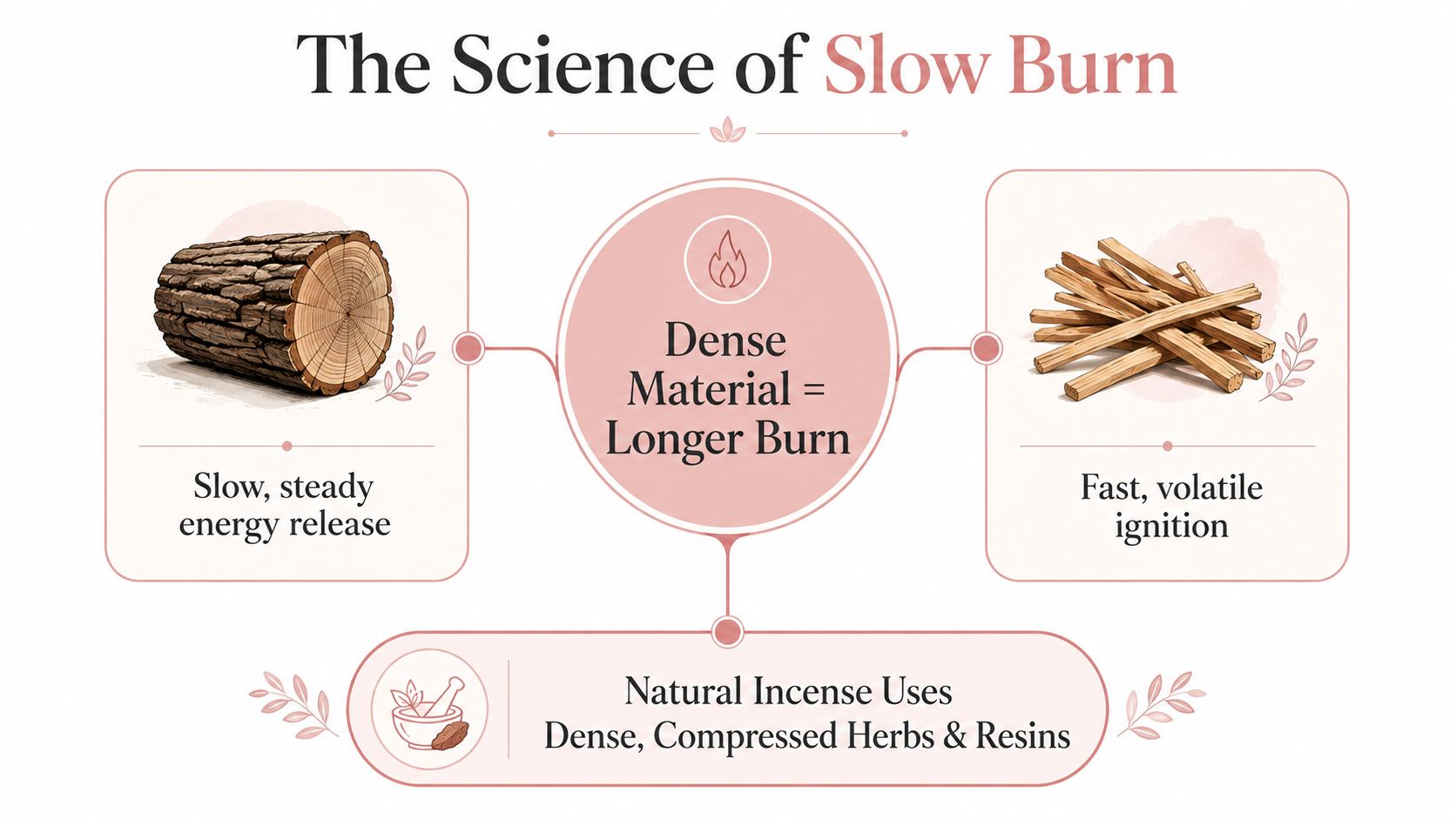
Think of a campfire. A dense hardwood log settles into a steady glow, while a handful of dry kindling catches quickly and disappears. Incense works in a similar way. The smoulder front moves through the material, and the way that material is assembled affects how quickly it travels.
In the Australian market, long-lasting incense sticks commonly benchmark at about 30 to 60 minutes per stick, with some premium products advertised at approximately 75 minutes per stick. Thicker or denser sticks contain more combustible material, which slows the smoulder front and extends the burn duration. This relationship between geometry, combustion load and runtime is described in this Australian incense-burning guide.
Three pieces of the slow-burn puzzle
Ingredients matter first. Natural resins, woods, herbs and plant-based binders can behave differently from charcoal-heavy filler. The composition influences how hot the stick burns, how evenly it smoulders and whether the fragrance feels rounded or sharp.
Density controls the pace. A tightly compressed stick gives the ember more material to work through. A loosely packed stick can burn more quickly, much like kindling rather than a substantial log.
The core changes the experience. Some sticks are rolled around a central support, while others are made without that type of core. The core and paste together affect the stick's structure, combustion load and the character of the smoke.
The useful idea: a longer burn usually comes from how much material the smoulder must travel through, not from a magical extra-long flame.
Thickness also matters because a wider stick carries more combustible material along its length. That's why two sticks that look similar on the shelf can have noticeably different runtimes once lit.
If you're comparing a locally available option, Blushing Ivy Luxury Incense is described as releasing a soft, lingering aroma and is available in Sea Salt, Sandalwood & Vanilla, Sweet Orange, Bergamot & Patchouli, and Basil, Neroli & Jasmine. Its care instructions recommend a suitable heat-resistant holder, a stable non-flammable surface, storage away from direct sunlight and burning in a well-ventilated area.
Reading Burn Time Like a Pro
Burn time is one of the most useful practical specifications on an incense product page. It helps you compare the actual ritual you're buying, rather than guessing from the number of sticks in a box or the word “premium” on the label.
The first trap is the difference between minutes per stick and total burn time per box. A pack can contain plenty of slender sticks yet offer less total fragrance time than a smaller-looking pack with denser sticks. Always check which figure the seller is giving you.
For a 20-stick box, the Australian benchmark works out to roughly 10 hours of total burn time at 30 minutes per stick, or about 25 hours at 75 minutes per stick, based on the stated per-stick durations. That's a considerable difference if you're choosing incense for regular evening rituals.
| Sticks per box | Approx. minutes per stick | Total burn time per box |
|---|---|---|
| 20 | 30 | About 10 hours |
| 20 | 60 | About 20 hours |
| 20 | 75 | About 25 hours |
Per stick or per box
Australian product pages sometimes lead with the total box figure. One Australian range lists 60 sticks at about 20 minutes each for roughly 30 hours total, while another lists 60 sticks at about 75 minutes each for 25 hours total. Those examples show why the number of sticks and the claimed total time need to be read together, not separately. You can compare that product-page approach through this Australian incense listing.
A sensible label-reading habit looks like this:
- Find the unit: Check whether the claim applies to one stick or the complete pack.
- Check the count: Note how many sticks are included before judging value.
- Do the simple maths: Multiply the per-stick duration by the number of sticks, while remembering that “about” signals an estimate.
- Think about your room: A longer runtime may not suit a compact, poorly ventilated space.
For the practical side of lighting, placing and extinguishing a stick, our guide on how to use incense sticks is a useful companion.
The Self Care Pack takes a broader approach to an everyday ritual. It includes a face and body lotion, hand and body wash and a 400g Australiana Candle, with Kookaburra & Banksia, Australiana Fairytale and Monochrome Natives designs available.
How to Choose Natural Incense That Lasts
A dense cloud of smoke can make a fragrance feel powerful, but more smoke isn't the same as better value. A well-made stick should give you a steady scent you can enjoy, not a plume that takes over the room and clings heavily to soft furnishings.
Start with the product description. Look for clear information about the materials, fragrance approach, core construction and expected burn behaviour. If the wording only promises intensity but says little about what the stick contains, you're left judging a product by its packaging rather than its making.
A gentler buying checklist
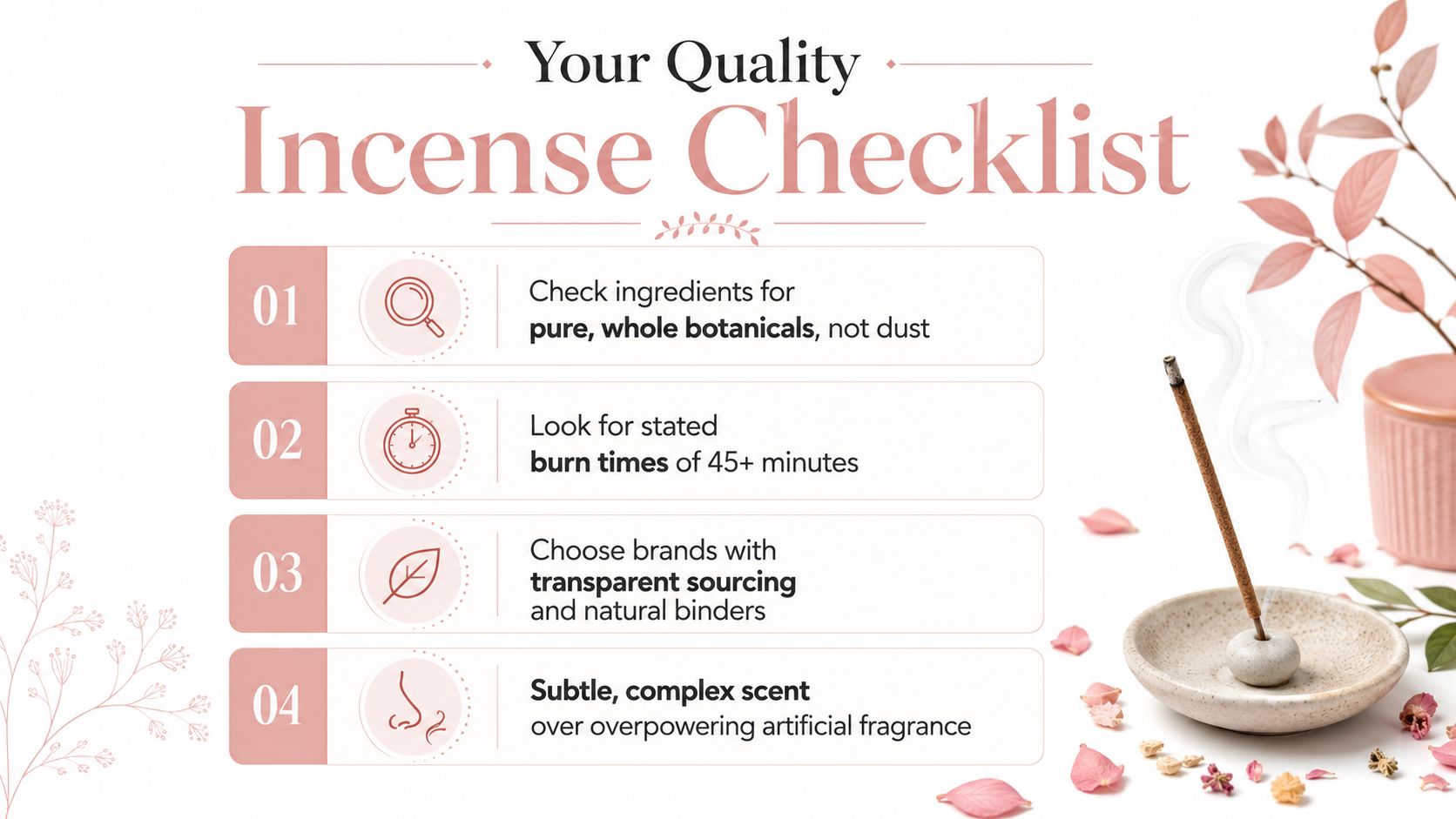
Look for transparent ingredients. Plant-based materials, natural resins, woods and clearly described binders give you more useful information than a broad “fragrance” label alone. Essential-oil-based fragrance can also be a helpful marker for shoppers who prefer a more natural scent direction, although it doesn't remove the need for careful ventilation.
Notice the scent before burning, if you can. A complex fragrance should suggest its character without smelling aggressively chemical or one-dimensional. Think of the difference between opening a jar of crushed herbs and walking past an overpowering air freshener.
Ask how the stick burns. A predictable smoulder, manageable smoke and fine, consistent ash are more reassuring practical signs than a dramatic cloud. Product information should make the care and use expectations clear.
Australia's incense supply chain is heavily import-dependent. Over 90% of volume is supplied by manufactured goods from India, China and Vietnam, while stick incense represents approximately 65–70% of sales by volume, according to this Australian organic incense market analysis. That makes ingredient and sourcing transparency especially useful for Australian buyers who want to understand what they're bringing into their homes.
For more on choosing a plant-focused option, you can browse our guide to natural incense sticks. The aim isn't to chase the longest possible ember. It's to find a stick that lasts beautifully while keeping the fragrance experience balanced.
Burning and Storing Your Incense the Right Way
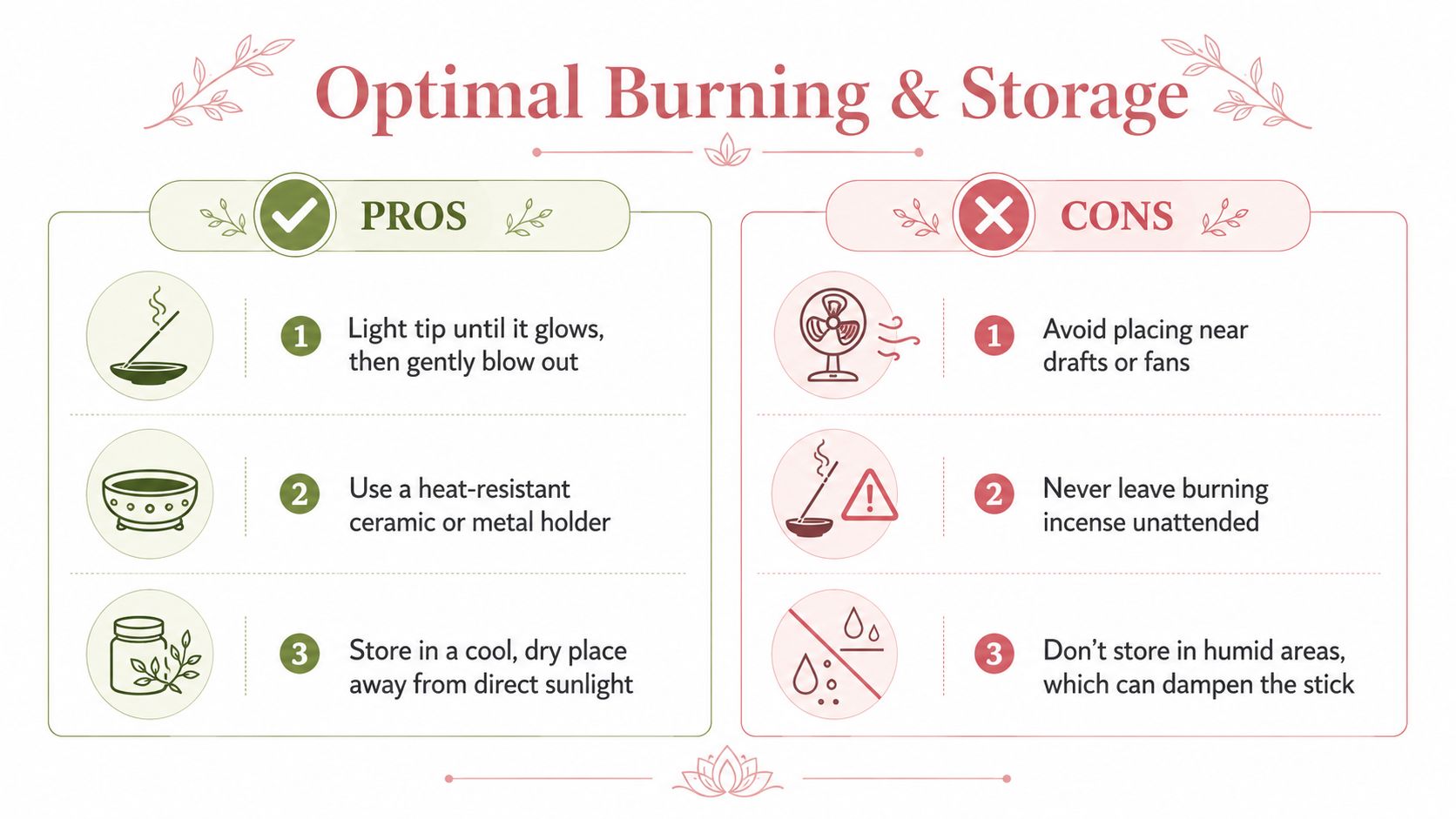
Even a beautifully made stick can burn too quickly if it's placed in a draught. An open window, ceiling fan or air-conditioning vent feeds the smoulder with moving air, which can shorten the burn and scatter the fragrance before it has time to settle.
Start with the tip. Let the flame catch, then gently blow it out so the end continues to glow and smoulder. Place the stick in a heat-resistant ceramic or metal holder on a stable, non-flammable surface, with ash falling onto a heatproof tray.
Small habits that protect the ritual
- Choose still air: Keep the holder away from fans, vents and strong cross-breezes. Gentle airflow is different from a direct draught that makes the ember race.
- Give the scent room: Burn in a larger or well-ventilated room where the fragrance can build without becoming concentrated in one little corner.
- Keep watch: Never leave burning incense unattended, even if the stick is designed for a long, steady burn.
- Store it thoughtfully: A cool, dry place away from direct sunlight helps protect the fragrance and keeps humidity from affecting the stick.
- Keep it secure: Children and pets shouldn't be able to reach the burning stick, holder or ash.
A bathroom shelf may seem convenient, but humidity can affect incense over time. Your linen cupboard or a closed drawer in a dry room is usually a better home, provided the sticks aren't exposed to heat or direct sun.
For a quick visual demonstration of the lighting process, watch this incense-burning video guide.
Matching Scents to Rooms and Moments
Scent can change the emotional temperature of a room. Sea Salt, Sandalwood & Vanilla has the feeling of a coastal evening after the heat has lifted, with salty air at the window, warm timber underfoot and a creamy sweetness that makes the bedroom feel wonderfully tucked away.
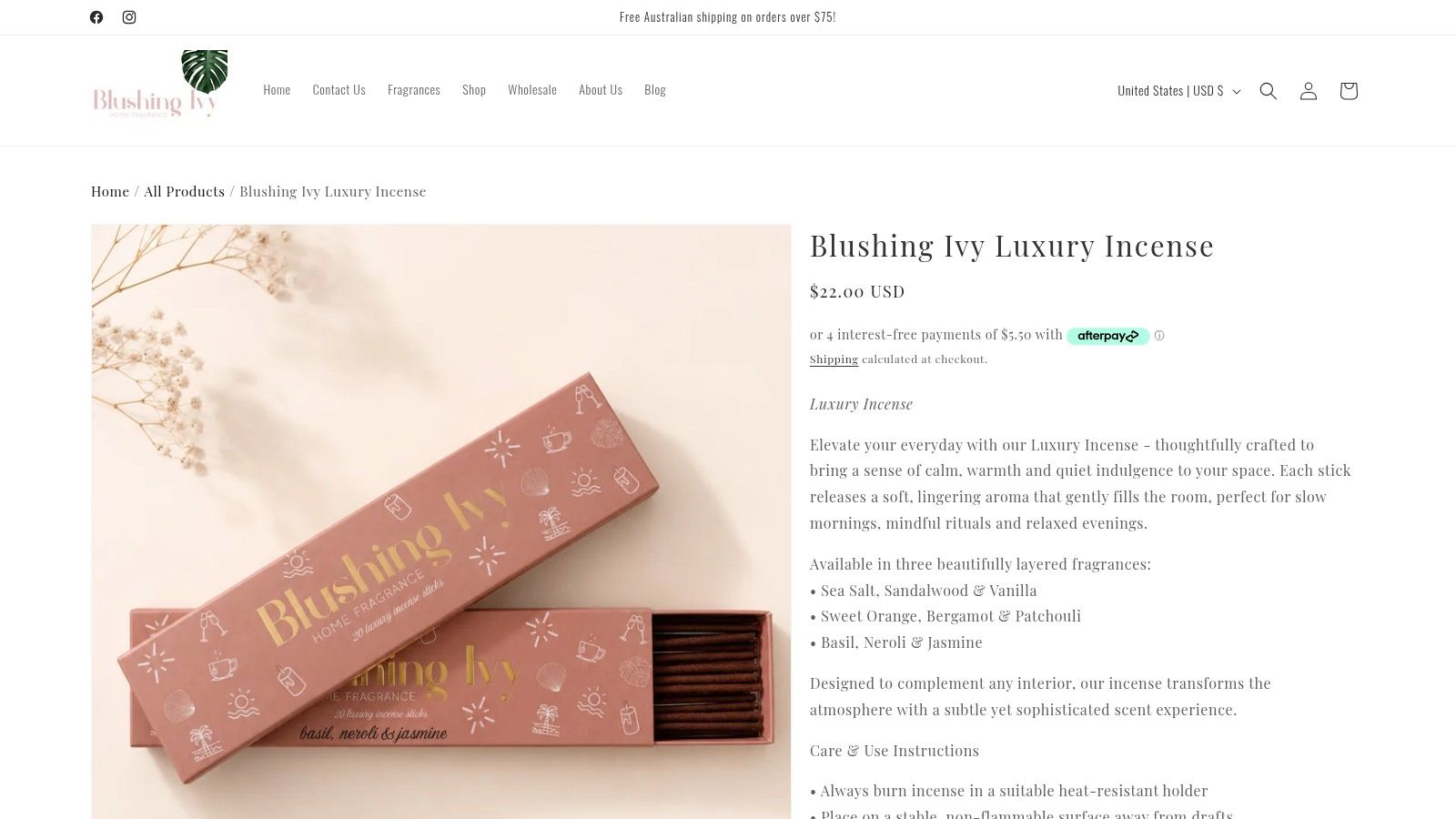
Three fragrances, three little rituals
Sea Salt, Sandalwood & Vanilla belongs in a bedroom, quiet living room or evening reading nook. It's grounding without feeling heavy, like a slow walk near the coast when the sky turns lavender and the day finally stops asking questions.
Sweet Orange, Bergamot & Patchouli suits a slow morning in the kitchen or studio. Bright citrus brings a lift, while patchouli adds an earthy base, a bit like golden Queensland light landing on a wooden bench beside a bowl of fresh fruit.
Basil, Neroli & Jasmine has a serene, green-floral character for meditation, a Sunday reset or a tidy little workspace. It suggests leafy gardens, soft bush florals and the calm that arrives after you've opened the doors, changed the sheets and decided the rest of the day can take care of itself.
Room pairing doesn't need to be strict. If your home office is also your craft room, choose the fragrance that helps you feel present there. If your living room is where everyone gathers, a layered scent with a softer trail may feel more welcoming than an intense, smoky blend.
The loveliest match is often the one connected to a place or memory. A coastal fragrance might take you back to sunscreen and salty air on a summer afternoon, while a botanical blend can bring the feeling of a garden after rain. Let your nose have the final say.
Care, Safety and a Gentle Word on Ventilation
Incense is a combustion product, which means the stick produces smoke and particles as it burns. Research cited in Australian product guidance has reported substantial particulate emissions, including averages above 45 mg of aerosol per gram burned in one study and about 222 μg of PM2.5 per gram of incense in separate exposure research. Polycyclic aromatic hydrocarbons have also been measured during combustion, so a longer burn can extend the time your indoor air is exposed. These findings are summarised in this Australian incense product and safety guidance.
That information doesn't need to make your ritual feel alarming. It gives you a sensible reason to choose your room and holder carefully. NSW Health advises regularly ventilating the home and considering limits on burning candles and incense, while Australian reporting has also described particulate matter and gases including carbon monoxide, sulphur dioxide and oxides of nitrogen in incense smoke. This Australian indoor-air-quality report provides further context.
A calm, sensible routine
- Use a proper holder: Choose a heat-resistant holder that catches ash and sits securely on a non-flammable surface.
- Ventilate well: Larger rooms and gentle ventilation are preferable to burning in a tiny, closed space. Avoid a direct draught, because it can make the stick burn faster.
- Keep everyone safe: Place incense away from children, pets, curtains and anything that could catch fire.
- Stay nearby: Never leave a burning stick unattended.
- Finish properly: Extinguish the stick fully after use and let the ash cool before disposing of it.
- Notice your home: If smoke feels heavy or irritating, put the stick out, open the room up and choose a shorter or gentler ritual next time.
For a warmer, plain-English look at the question of whether natural incense is suitable for your space, see Is natural incense bad for you. The right answer depends on how much you burn, where you burn it and how well the room is ventilated.
Blushing Ivy Home Fragrance offers handcrafted Sunshine Coast scents across natural incense, soy candles, fragrance diffusers, room and linen sprays and gift sets. Visit Blushing Ivy Home Fragrance to explore a slow-burning incense ritual and find the fragrance that feels most like home.