

Soy Wax Candles Benefits That Make Home Scent Better
You know that moment when you finally kick off your shoes, the dishwasher is humming, and the house needs a little mood shift before your brain will agree that the day is over? You light a candle because you want warmth, softness, and that lovely little exhale a good scent can bring. You don't want the room to feel heavy. You don't want black smudges on the jar. You just want your home to smell beautiful and feel calm.
That's where the conversation about soy wax candles benefits gets interesting for real life, especially in Australian homes where open-plan living, smaller bedrooms, apartments, ceiling fans, and summer airflow all change how a candle behaves. A soy candle isn't magic. But when it's made well and burned well, it can feel gentler, cleaner, and more relaxed in everyday use.
At Blushing Ivy, up here on the Sunshine Coast, we love that home fragrance can feel both cosy and considered. The wax matters, yes. The wick matters too. So does the fragrance system, the room size, and whether you've trimmed the wick or popped a window open a touch.
If you've ever wondered why one candle feels fresh and elegant while another feels a bit smoky and fussy, that's what we're unpacking here. If you're curious about scent performance too, our thoughts on scent throw in candles pair nicely with this chat.
Table of Contents
- Why Soy Wax Candles Feel Different at Home
- What Soy Wax Is and How It Creates a Gentle Burn
- Cleaner Burning and Indoor Air Comfort Explained
- How Soy Compares with Paraffin and Other Waxes
- Eco Friendly Scent and Mood Benefits You Will Notice
- Simple Care Tips to Get the Most from Your Soy Candle
- Choosing Your Perfect Soy Candle for Home and Gifting
Why Soy Wax Candles Feel Different at Home
A lot of people notice the difference before they know how to explain it.
It's not usually some dramatic movie scene where the candle changes your life. It's more everyday than that. You light one while folding washing on the bed. You pop one on during a Sunday tidy-up. You let it glow on the kitchen bench while rain taps on the windows and dinner simmers away. The room feels softer, but not crowded.
That's one of the most loved soy wax candles benefits. In a home setting, soy often feels lighter and steadier. The experience can be less about a big blast of fragrance and more about a gradual, comfortable scent that settles into the space.
The home feeling people are really chasing
Most of us aren't shopping for wax in the abstract. We're shopping for a feeling.
Usually, it's something like this:
- Calm after a busy day so the house feels less chaotic
- A cleaner kind of cosy without obvious soot around the jar
- Scent that suits real rooms like smaller studies, bedrooms, and open living spaces
- A more thoughtful gift that feels a bit special, not last-minute servo flowers energy
Soy candles fit neatly into that picture because they're often chosen by people who care about atmosphere as much as ingredients. The wax is part of the story, but not the whole story.
A good candle should feel like part of your home rhythm, not a thing you have to manage constantly.
Why Australian homes make this question more practical
In Australia, candle choices aren't just aesthetic. They're practical.
We've got homes with ceiling fans going half the year, coastal humidity, compact apartments, big family zones, and plenty of people who love scent but don't want a room to feel stuffy. That's why the best conversation about soy wax isn't “Is soy perfect?” It's “When does soy work beautifully, and what helps it perform well?”
That's where soy tends to shine. It often suits people who want a soft, inviting burn for regular home use, especially when the candle is made properly and used with simple care.
What Soy Wax Is and How It Creates a Gentle Burn
Soy wax sounds fancy, but the idea is quite simple. It's a plant-based wax made from soybean oil that's been processed into a solid form suitable for candles. If that sounds a bit technical, some ingredients stay runny at room temperature, and some become firmer and more stable when prepared differently. Candle wax works in that same sort of practical, everyday way.
Because soy wax generally melts at a lower temperature than hotter-burning wax types, many people find the burn feels more measured and even. That slower melt is part of why soy candles are often described as having a softer, more relaxed personality at home.
Think of it like butter versus cooking oil
A kitchen analogy helps here.
Different fats react differently to heat. Some melt quickly and gently. Others need more heat and behave differently in the pan. Candle waxes are similar. Soy wax tends to form a melt pool with a lower, steadier heat profile, which can support a smoother fragrance release when the wick and formula are balanced properly.
That's why the wax alone never tells the whole story. A candle also needs:
- A suitable wick so the flame isn't too large or too weak
- Proper curing time so wax and fragrance settle well together
- A sensible vessel that handles heat safely
- Good burn habits from the person using it at home
Why the wick matters just as much
This is the bit people often miss. A soy candle can still perform poorly if it's badly wicked.
If the wick is too large, the flame can run too hot and create more smoke than you'd expect. If it's too small, the candle may tunnel and waste wax around the edges. A well-made soy candle aims for that happy middle ground where the wax melts evenly, the scent lifts gradually, and the flame stays calm rather than wild.
Worth knowing: Wax type gives a candle its character, but wick choice often decides whether that character shows up beautifully or badly.
For people who want fragrance without a flame, Pure Soy Wax Melts offer a different format using premium natural soy wax. They're hand-poured melts designed to give a long-lasting, balanced fragrance experience in a warmer, which can be handy in spaces where you want scent without lighting a candle.
What a gentle burn usually looks like
In practice, a gentle burn means the candle doesn't feel fussy.
The flame stays reasonably steady. The top layer of wax melts without racing. The fragrance unfolds through the room instead of hitting you all at once. It feels a bit like opening the house to a coastal breeze rather than spraying half a perfume counter into the hallway.
That's the practical foundation behind many soy wax candles benefits. The softer feel people notice usually starts with the mechanics.
Cleaner Burning and Indoor Air Comfort Explained
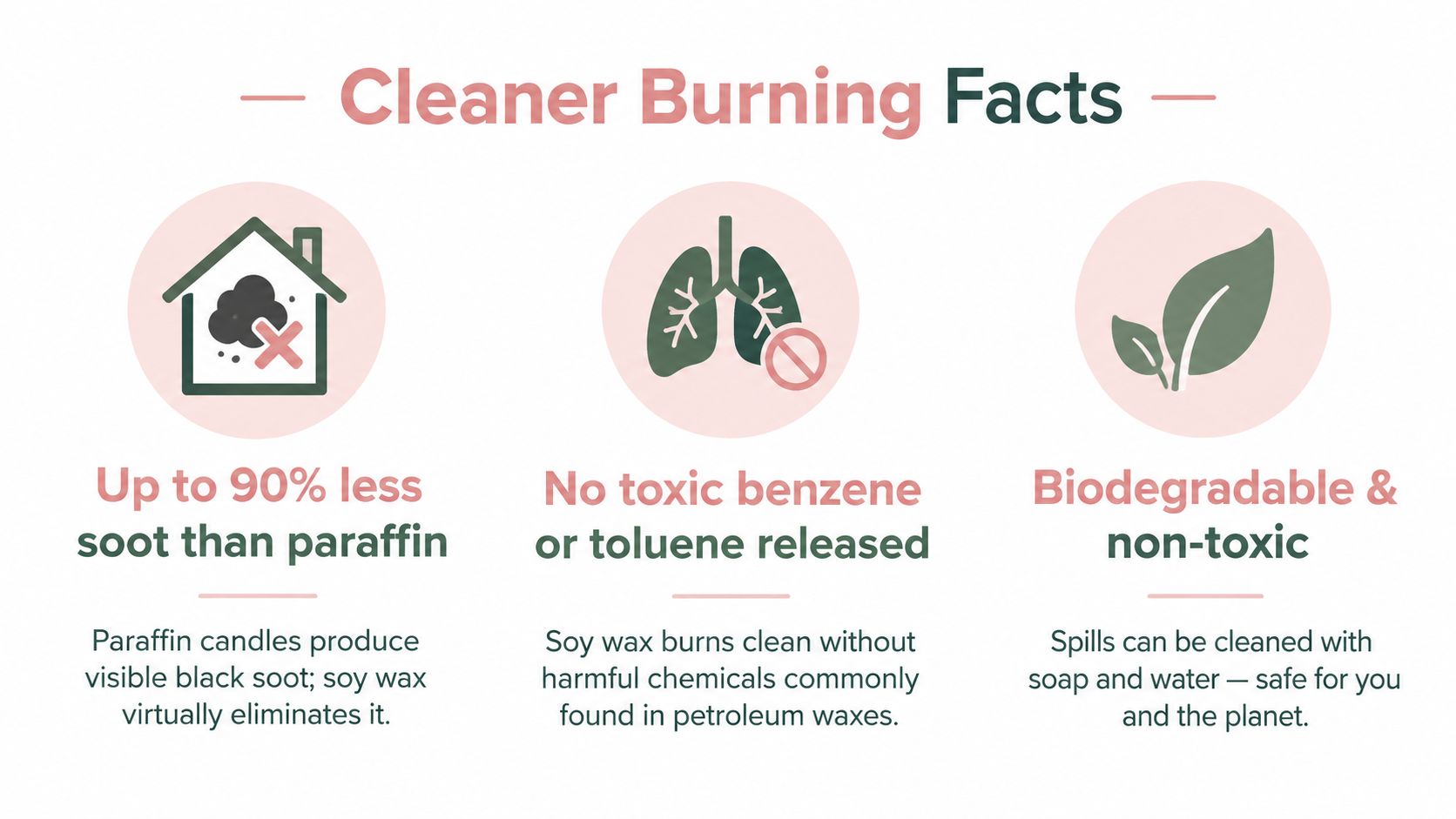
When people say a candle burns “cleaner”, they usually mean two things. They mean less visible soot and a more comfortable indoor experience.
That matters because candle smoke doesn't just vanish into the universe. Tiny particles can stay in the air, and some of what you notice first is visual. Dark marks near the rim, smudging on nearby surfaces, or that slightly smoky feeling in a room that's had a candle going for ages.

What one particulate comparison found
A useful older comparison looked at fine particulate matter, or PM2.5, from different candle types. In that student science project, paraffin candles emitted 50- to 60-fold higher PM2.5 concentrations than soy wax candles, and the soy candles produced only about twice as much PM2.5 as the matches alone according to the National Candle Association summary of the PM2.5 comparison.
That helps explain why soy has built such a strong reputation among shoppers who dislike visible soot. If you've ever had a candle leave a grubby-looking jar edge, you'll understand why this matters.
Why that still doesn't mean every soy candle is automatically cleaner
Here's where the conversation needs a bit more honesty.
A separate research summary hosted in Australia notes that the Ökometric emissions work found “well-made candles of all major wax types exhibit the same clean burning behavior” and that their combustion byproducts were “virtually identical in composition and quantity,” with emissions “far below” the most restrictive indoor-air standards, as quoted in this Australian discussion of sustainable soy candles and the underlying research summary.
So which idea is right? Both can be useful.
One finding supports the common lived experience that soy can be a cleaner-burning option than paraffin in practical home use. The other reminds us that build quality matters enormously. A beautifully wicked candle can outperform a poor one, no matter what label is on the box.
Practical rule: If a candle flames too high, mushrooms at the wick, or burns in a draught, the wax can't rescue bad burn conditions.
Indoor comfort matters more than marketing words
For Australian homes, especially smaller ones, the bigger question isn't “Is soy non-toxic?” That language gets messy quickly and often oversimplifies. A better question is, “How do I keep candle use comfortable indoors?”
ABC coverage on indoor air quality makes an important point. There is no safe threshold for particulate matter, and even soy, beeswax, or other non-paraffin candles should still be used in moderation with ventilation or filtration, as noted in this ABC article on how scented candles affect indoor air quality.
That's why good candle habits matter so much:
- Trim the wick so the flame stays controlled
- Avoid stuffy rooms where smoke builds up
- Use ventilation especially in bedrooms, studies, and apartments
- Don't overdo burn time if the room is small
Soy can absolutely be a lovely option for everyday home fragrance. It just works best when “cleaner burning” is treated as a combination of wax, wick, airflow, and common sense.
How Soy Compares with Paraffin and Other Waxes
If you're choosing between wax types, it helps to stop thinking in black-and-white terms. Soy isn't the answer to everything, and paraffin isn't the same in every candle either. The more helpful question is which wax suits your priorities at home.
Some people want slower, cosier fragrance for evening use. Some want punchier scent. Some care most about biodegradability. Others are buying gifts and mainly want something elegant, easy to use, and nicely made.
A simple side-by-side view
| Feature | Soy Wax | Paraffin Wax | Beeswax / Blends |
|---|---|---|---|
| Burn feel | Often gentler and slower-burning in home use | Often hotter-burning | Varies widely depending on the blend |
| Soot tendency | Often chosen for a lower-soot experience when well wicked | More likely to be associated with visible soot in consumer comparisons | Can perform very well, but depends on formulation |
| Fragrance style | Often steady and smooth | Can throw scent strongly | Can be subtle or varied in blends |
| Biodegradability | Soy-based waxes can break down substantially under biodegradation testing conditions | Not typically chosen for biodegradability | Depends on ingredients |
| Best for | Everyday home fragrance, gifting, softer atmosphere | Budget or stronger mass-market scent profiles | Natural-style options and specialty blends |
Where soy tends to win
For many households, soy gets the nod because it usually lines up well with the kind of candle experience people want at home. Softer glow. Slower consumption. Less visual mess. A fragrance release that feels more graceful than shouty.
There's also a sustainability angle. Independent research published in 2026 found soy wax bead samples showed 74% mass loss by day 45 and 99% degradation by day 180 under biodegradation testing conditions, which supports the idea that soy-based waxes can break down substantially over time in that setting, according to the 2026 biodegradation study in Sustainability.
Where formulation matters more than wax labels
This is the bit I wish more candle guides would say plainly. A label saying “soy” doesn't guarantee a beautiful burn.
Technical summaries note that soy formulations typically burn at a lower temperature and can consume fuel more slowly, which supports longer burn times per gram of wax compared with hotter-burning blends. But they also note that over-wicked candles produced higher levels of the studied compounds, even while remaining below applicable air-quality standards, in this candle emissions and home fragrance summary.
That means the comparison isn't just soy versus paraffin. It's often well-made versus poorly made.
If you'd like a deeper wax-to-wax comparison, our guide to soy wax vs paraffin wax goes into the differences in a bit more detail.
Eco Friendly Scent and Mood Benefits You Will Notice
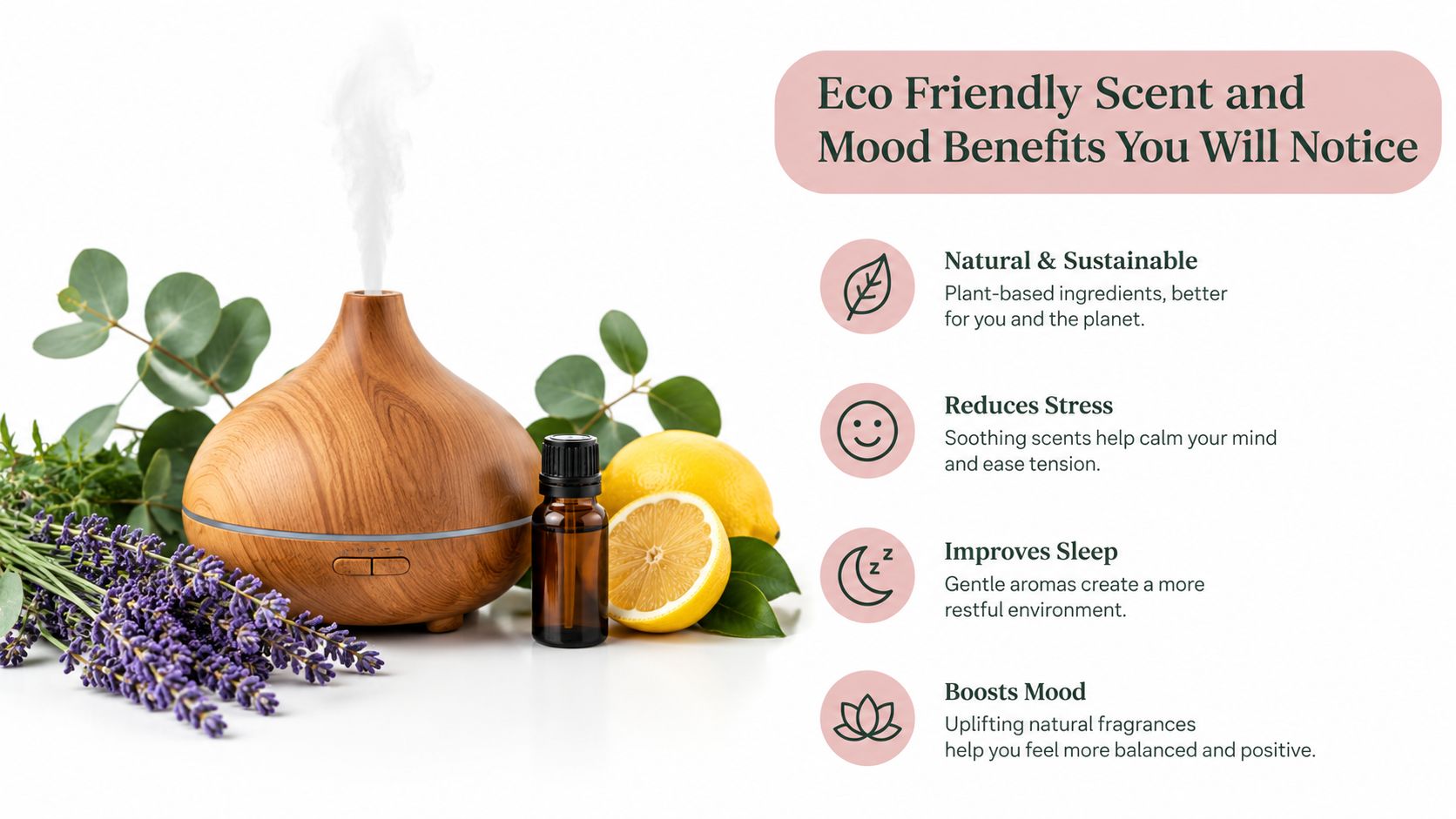
The loveliest soy wax candles benefits aren't only about what's missing. Less soot. Less heaviness. Less mess. They're also about what you notice more clearly. The scent itself. The mood. The little ritual of making a room feel like yours again.
That's where wax and fragrance work together.
Why the fragrance system matters as much as the wax
A beautiful candle isn't just wax in a jar. It's the whole fragrance system. Wax, wick, fragrance composition, curing, and how the scent opens in the room.
That matters because Australian shoppers are paying more attention to ingredient transparency. Recent local trend coverage says demand for transparency in home-fragrance ingredients has reached an all-time high, with shoppers actively seeking natural essential oils, coconut-soy blends, phthalate-free fragrances, and memory-forward scents, according to this Australian home fragrance trends article for 2026.
So if you're choosing a candle for wellbeing, comfort, or gifting, don't stop at “soy”. Ask what's carrying the scent story.
- A wax can burn beautifully, but the fragrance blend still shapes the experience.
- A cleaner-feeling candle can still feel too strong if the scent formula is sharp or overpowering.
- A softer scent profile often feels more liveable in bedrooms, studies, and smaller lounge rooms.
Mood lives in the details
Home fragrance becomes delightfully personal.
A candle with native, honeyed, or bush-floral notes can feel grounding in a way that takes you straight back to a warm Queensland afternoon. A saltier, airy scent can feel like freshly opened windows after a sticky day. Something woody and smooth can make a winter evening feel a little more tucked in, like socks on, tea poured, no plans required.
The candle you love most usually isn't the one with the fanciest ingredient list. It's the one that makes your home feel more like you.
That's why memory-forward fragrance matters. We don't just smell notes. We connect them to place, people, and mood.
A scent can remind you of sunscreen and coastal breeze, a bush walk after rain, linen crisp from the line, or the polished calm of getting the house lovely before friends pop over. That emotional side is often what people are really buying.
Here's a helpful visual break if you enjoy the mood side of home scent:
Eco-friendly can still feel elegant
Some people hear “eco-friendly” and worry it means worthy, plain, or faintly smelling of nothing much at all. Thankfully, no.
Plant-based wax and thoughtful fragrance design can still feel polished and indulgent. In fact, that's often the sweet spot. You get the comfort of a more considered wax base, plus a scent that lifts the room and creates a mood that lingers after the candle is extinguished.
That's a much more useful way to think about benefits. Not just “Is soy better?” but “Does this whole candle make my home feel good to live in?”
Simple Care Tips to Get the Most from Your Soy Candle
A soy candle can be beautifully made and still burn poorly if the basics are ignored. The good news is that the care routine is simple. A few small habits make the soy wax candles benefits much more noticeable in real life.
If you want a candle to burn evenly, smell balanced, and stay looking nice, the magic lives. Not glamorous, perhaps. Very effective, absolutely.
Start well and the candle behaves better
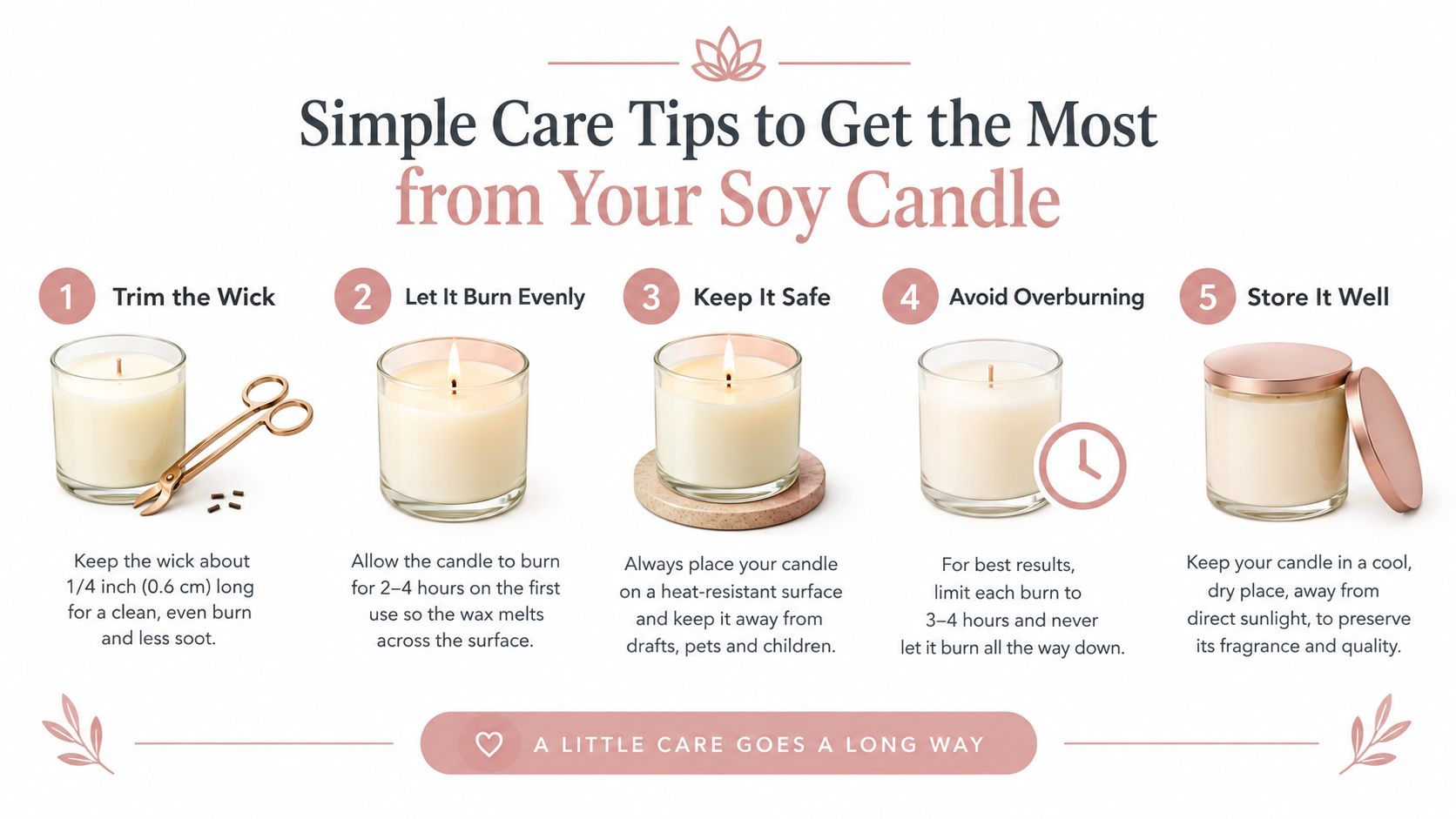
The first burn matters more than people think. The wax pool should reach the edge of the container so the candle sets a good “memory” for future burns. If the first burn is cut short, tunnelling is more likely.
That's one reason people often look up soy candle burn time, especially when they're trying to work out why one candle lasts nicely and another wastes wax around the sides.
Your quick at-home checklist
- Trim the wick to 2 to 5mm. The Classic Soy Candle product guidance recommends keeping wicks 2-5mm for effective burning and minimising soot build-up, and the same product uses lead free cotton wicks.
- Keep the candle away from draughts. Ceiling fans, open windows, and air con can make the flame flicker and burn unevenly.
- Give smaller rooms some airflow. This matters in apartments, studies, and bedrooms where air can get stale more quickly.
- Don't leave a candle unattended. Obvious, yes. Still worth saying because we've all wandered off to “just do one thing”.
Safety details that are worth knowing
Australian safety rules are refreshingly concrete here.
Candle wicks containing more than 0.06% lead are permanently banned for sale in Australia, whether they're sold with a candle or separately, according to the Victorian product safety guide for businesses. The ACCC also says combustible candle holders and decorations are permanently banned if they ignite and continue to burn for 5 or more seconds, as set out in the ACCC combustible candle holders ban.
Keep the setup simple. A stable holder and fewer decorative extras around an open flame usually means fewer problems.
The ACCC has also warned that unsafe candle-related products can create serious fire hazards, including recalls involving holders and decorations that fail safety expectations, as noted in this ACCC warning about dangerous candle holders and decorations.
One practical product example
A factual example of a well-specified soy option is the Classic Soy Candle. It's made with 100% pure, vegan friendly soy wax, lead free cotton wicks, and Australian Made, essential oil based fragrances, with product guidance that also covers first-burn memory and wick trimming. Those are the sorts of details worth looking for in any candle, whichever brand you choose.
Choosing Your Perfect Soy Candle for Home and Gifting
Choosing a soy candle gets much easier when you stop shopping by label alone.
The best picks usually have a few things in common. Clear wax information. Cotton wicks. Fragrance details that don't feel vague. Care guidance that tells you how to burn it properly. Packaging that feels giftable without being overdone. In short, a candle that looks considered because it probably is.
What to look for first
If you're buying for your own home, match the candle to the room and the mood.
For a bedroom or study, many people prefer something softer and more serene. For an entryway or living area, you might want a scent with a little more presence. If you're gifting, think about the person's style as much as the fragrance itself. Some love pretty florals and coastal freshness. Others lean toward deeper, more refined notes, which is where the Wild Heath Society range can be a lovely fit.
Thoughtful gifting beats generic gifting
Soy candles make easy gifts, but they don't have to feel predictable.
A well-chosen candle works for birthdays, housewarmings, thank-yous, and those “saw this and thought of you” moments. If you're building a gift around candle styling too, these owl candle holder gift ideas from Pandemonium Millinery are a fun, practical read for anyone who likes decorative touches without going overboard.
The nicest candle gifts feel personal. A scent that suits someone's space or reminds them of a place they love will always beat a random jar grabbed in a rush.
For many Australian shoppers, that's part of the appeal of Sunshine Coast handcrafted fragrance. It feels warm, local, and a bit more human. Not mass-made. Not soulless. Just thoughtfully chosen.
If you're ready to bring these soy wax candles benefits into your own space, Blushing Ivy Home Fragrance offers Australian-made home scents crafted with 100% natural soy wax and essential oil-based fragrance on the Sunshine Coast. You'll find candles, melts, diffusers, and gifting options designed for the kind of everyday home rituals we've been talking about. If you're not sure where to start, have a browse and choose the scent that feels most like your home.